New to my spanakopita series? Catch up on the story so far here.
***
There were many moments during episode 1 of this series where I honestly believed there would be no episode 2.
The whole debacle had left me with pink, tender-skinned hands, a kitchen that looked like the end of a MasterChef Pressure Test, and all in all a spanakopita that made me question whether I had what took to make an authentically delicious pie.
After clearing out the final piece of my first spanakopita, it was nearly two months before I could gather my strength to try again. I was eventually reinvigorated as we moved deeper into winter and my local farm box service shared photo upon photo of organic sunlit fields boasting giant bunches of spinach with delicate, sweet pink roots; verdant dill with its feathery fronds; and even kale, appearing in the form of curly, green, black and red.
I reviewed my shortlist of recipes again and, though I had decided commercial phyllo wasn’t fit for purpose here, I still had half a pack in the freezer, and its unorthodox use by Nagi of Recipe Tin Eats caught my eye.
Everything from Nagi’s recipe was unorthodox, in fact, from the sesame seeds scattered over the crust to the cayenne pepper and ‘intrusive’ garlic in the filling. But the way she inventively grated kefalograviera cheese between the layers of phyllo had me salivating in anticipation.
What then cemented my choice for my second Spanakopita Test Kitchen attempt was the fact that the filling involved no cooking. Nagi directs readers to simply chop the greens, massage salt into them and leave to sweat, then squeeze the liquid out of the cold, uncooked spinach. Aside from the fact that it sounded a lot less painful than working with scalding hot greens and bare hands, it also sounded a lot quicker and more efficient—and I wondered if it might help me achieve the ‘al dente’ filling I craved.
I eagerly ordered my farm box for the following week, hit up my local Greek grocer for the cheese, and then began to prepare.
***
I had learnt a few things from the trauma of my first spanakopita attempt and, quite apart from my takeaways about the pie itself, I realised that I needed to work smarter. I could either let it become a whole day affair, or I could stagger the process, breaking it up into manageable chunks that I could easily accomplish around a schedule of work, childcare, and life in general.
The day my farm box was delivered, I spent a couple of serene hours with my greens: separating, washing, spin drying, trimming, and then portioning them out. In one large bowl I meticulously weighed out everything I would need to create my next spanakopita, and popped it into the fridge for another day. I then set about wiping down all my kitchen surfaces, free from the anxiety of now trying to create a pie.
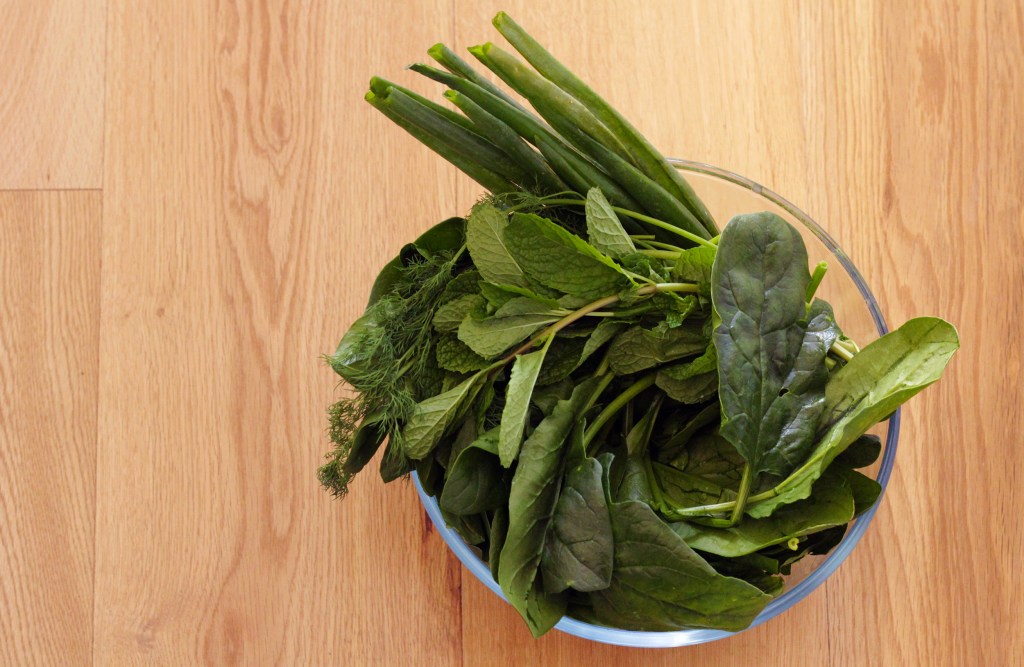
Two days later, retrieving my prepped greens from the fridge, I felt immensely smug. Pulling up the recipe again and setting to work, the contrast between this cook and the previous one was acute. I felt very zen with my clear countertops, doing civilised chopping of a very reasonable amount of greens (almost too reasonable. Where were all the herbs?); there were no puddles of green water in sight, and I needed only one bowl. The lack of cooking for the filling markedly simplified the whole process, as I could leave my spinach to sweat as I sliced spring onions and shredded herbs, then squeezed out the excess water and popped it all into a bowl within a cool 15 minutes.
I won’t pretend the cook didn’t have its challenges.
Sure, the greens were cool enough to handle, but my hands—dry, chapped and cracked from 12 months’ worth of constant sanitising and hand-washing and general COVID-19 prevention—did not respond well to massaging salt into greens.
And my time dedicated to preparing my greens beforehand had been well-intentioned but apparently not quite meticulous enough. Farm fresh produce is always going to be just that: fresh. Which also means farm fresh dirt and grit; while chopping later I found both my spinach and my spring onions had retained small pockets of dirt in their nooks and crannies that I had to retrospectively ferret out.
But overall I didn’t feel the same sense of stress, despair and resentment I had felt the first time. It all felt achievable and my original excitement for the whole project started to return.
I had also counted out and trimmed down my phyllo sheets at the start of my cook, meaning I could jump straight into the layering after stirring crumbled feta, yoghurt, egg, lemon juice and zest into my already-cool greens.
Nagi’s pie is a freeform one, calling for simply laying pastry sheets straight onto a flat baking tray, pouring the greens mixture over, then covering them up with the second half of pastry layers and sealing the edges.
While I enjoyed the freestyle crimping of the edges, having to stop and grate cheese between each layer of phyllo felt like a real faff and, even in a mild Brisbane winter, I worried that the melted butter was solidifying too quickly between the layers and would compromise the integrity of my crust. With a final flourish of apprehension I scattered the unconventional sesame seeds over the buttered crust and popped the tray into the oven with a silent prayer.
***
I picked up many new things in my first spanakopita attempt, but patience was not one of them.
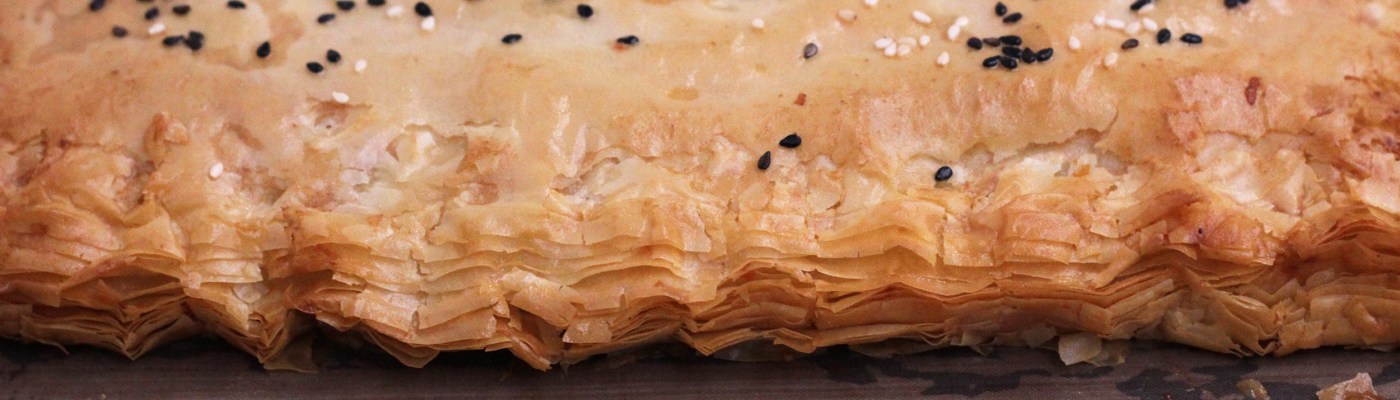
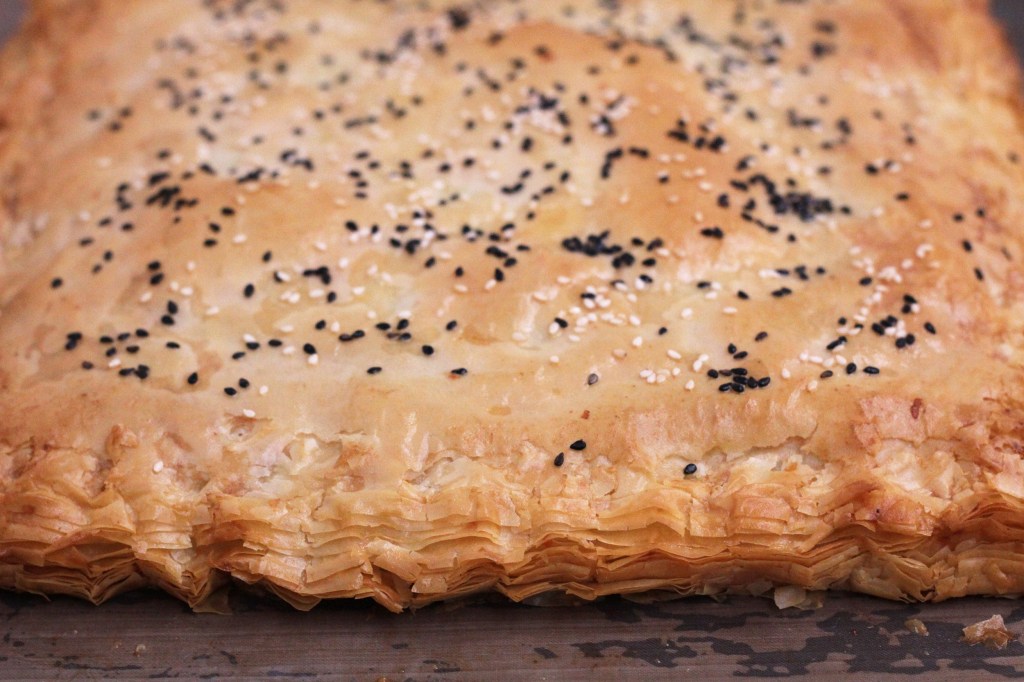
Once again, I cracked into my spanakopita while it was still hot from the oven. With crispy shards of golden phyllo flying and fragrant steam wafting toward me, I took a bite.
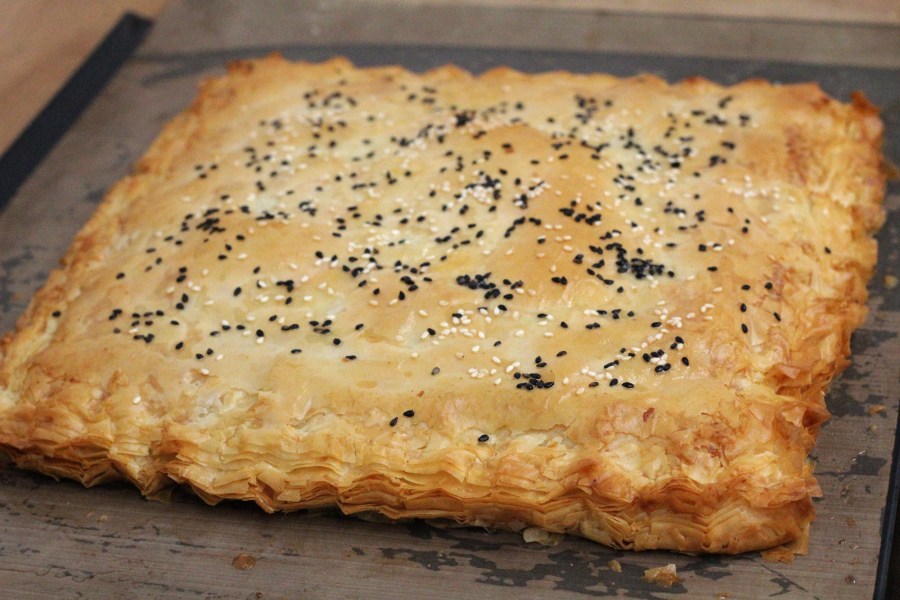
I was blown away.
Thoughts of the meagre quantity of herbs, the garlic, the cayenne pepper and sesame seeds were pushed aside as I was overwhelmed by the pure deliciousness that was the crust. I had been right to be intrigued by Nagi’s cheese-layered phyllo because, once cooked, it earned a two-syllable ‘damn!’.
I thought I had written off commercially-produced phyllo and, while I still intended to make my own pastry at least once, Nagi’s recipe gave me new hope that I could still use the store-bought stuff to great effect.
The copious amounts of butter certainly didn’t hurt either.
I turned my attention to the filling as it cooled, and found that, though the flavour was a little unexpected (particularly with the heat from the cayenne), it was mouthwatering all the same. The absence of cooking translated, not only to a simpler process, but to a filling that felt like it had retained greater flavour as well as texture. The sumptuousness wasn’t at all marred by the lack of herbs either. The texture was hearty and moist without being soggy, and held its own against the star that was the kefalograviera-laden-crust.
That crust.
I had learnt a key lesson today, which was, in fact, something I should have known all along: it’s all about the butter and the cheese.
And, of course, that the cheese belongs in the pastry, not just the filling.
I knew for sure that, eventually when I made my own phyllo by hand, I would be layering it with grated kefalograviera too.
 The Foodiarist
[…] the phyllo being such a triumph, I recalled the thrill of tasting the filling after my second attempt, and decided next to combine these efforts. While I still wanted to try the haloumi variation I had […]
LikeLike