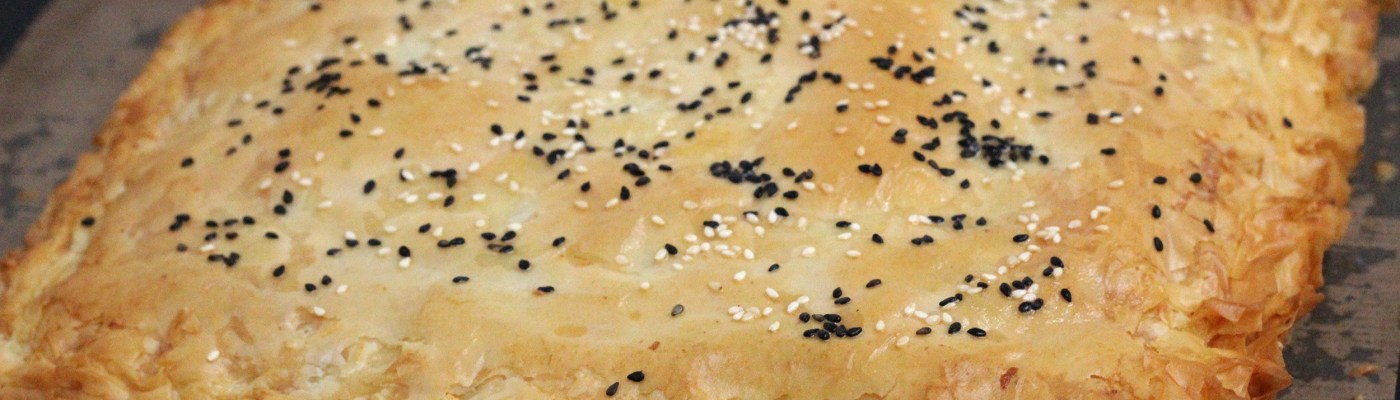
If you will allow me to wax nostalgic for a moment, let me tell you about the first time I discovered spanakopita (Greek spinach pie). It was, of course, in Greece, on a trip with my sisters some 10 years ago. We had just come from Turkey which, being a predominantly Muslim country, had presented us with a smorgasbord of delectable delights at every turn. We arrived in Greece somewhat disgruntled after a midnight border hold-up for our bus; surprised by the steep exchange rate (compared to the Turkish lira); and saddened by the abundance of meat products we couldn’t consume, alcohol, and menus that once again needed to be scoured carefully.
Enter the spanakopita.
In Thessaloniki, we walked past a roadside shop with humongous trays full of the stuff sitting innocuously in the window. We purchased a slice apiece, accepted them handed over with no more than a napkin, and went on our merry way, eating as we walked.
Within minutes, I had retraced my steps to purchase another piece.
Encased in a flaky yet tender, crumbly yet moist, golden crust, was a filling of hearty, bitter greens with the zip of an abundance of herbs, delicately balanced with the sweetness that only comes from slow-cooked alliums and peppered with salty white cheese. The rich indulgence of the cheese offset the earthy, herbaceous greens beautifully. The two pie elements were married perfectly, neither overpowering the other; the perfect ratio of pastry to stuffing.
For the next week, we proceeded to purchase a slab of pretty much every single spanakopita we encountered. Every version was slightly different. Some had a sturdier crust, golden with olive oil, while others favoured the commercially-produced-phyllo route with a multitude of flaky crisp layers. The filling varied between spinach (spanakopita) and a variety of other greens (hortopita)—silverbeet (chard), kale, cavolo nero and more . The combination of herbs and alliums included any selection of parsley, spring onion, mint, dill, leek, chervil, and others yet that we couldn’t name. Some filled their expansive tapsi (a traditional round, shallow, silver, baking tray) with rows of offset diamonds, while others formed logs that coiled round as a fat snail shell.
Whatever the form, spanakopita had our hearts and our tastebuds.
Upon our return to Australia we mourned the loss of the spanakopita. Everywhere we looked there were sad, soggy impersonators. Crafted with an inexpert hand in handling phyllo or even sometimes puff pastry, piped full of a mushy, tasteless cream of pureed spinach and flavourless dairy.
And yet I couldn’t help myself buying even these pale imitations at every turn, with the optimism of a girl in love. Dreaming that the true spanakopita and I would one day meet again. I searched for longer than I’m proud to admit, putting off the inevitable moment where I would make it myself. I had some success, thanks to Australia’s large population of Greek immigrants; but once the COVID-19 pandemic hit, my ability to source quality spanakopita dropped dramatically.
The moment had come.
Recipe hunting
I had certainly dabbled with the idea in the past. You don’t go 10 years dreaming of spanakopita without being tempted by a recipe or two. But I had always been paralysed with indecision and an overwhelming fear of producing a substandard pie.
What spanakopita and I had was true love. I didn’t want to sully that by trying just any old recipe. I certainly did not want to spend months working through a parade of mediocre recipes before finding The One.
I have made that mistake before — the mistake of attempting a new recipe without doing my due diligence, and I typically ended up underwhelmed, sometimes to the point of giving up after only one attempt. Case in point: the first time I tried making lemon meringue pie it was in the middle of a humid, sub-tropical Brisbane summer, and I had never made meringue before nor did I understand the principles involved. The resulting meringue was fluffy (not in a good way) and so sticky that I didn’t make it again for many years. I gave up on lemon meringue pie as a whole too, and instead asked my food photographer, baker, recipe developer sister to do it for me.
I carry the savoury torch in our family though, so after she had developed the perfect lemon meringue pie recipe for me, it looked like it was up to me to develop the perfect spanakopita pie recipe for her. Well, for me. And for her. For the world.
Unfortunately, I didn’t quite know what perfection would mean. I knew what I wanted when I tasted it, but having no frame of reference for the varying recipes, I didn’t know how to match that taste with the individual ingredients and elements in the process. It looked like I would indeed have to trawl through a parade of pies, but they didn’t have to be substandard. Variations of spanakopita are enjoyed across the eastern Mediterranean and the Middle East and, being no stranger to this style of cooking, I discovered I had a number of recipes to hand in the cookbooks already on my shelf. I decided to start there.
After poring through these recipes, and a discerning search online, I identified some key elements with their own variations:
The pastry
I already knew that my primary choice would be between handmade or commercially produce phyllo. But within that broad distinction, I found more confusion. If making my own dough, should I start with 00 flour or wholemeal, or just plain? Do I use both olive oil and yoghurt? How many layers do I use? That question holds for both types of pastry, but store-bought phyllo gets even more confusing. Do I brush between the layers with butter or olive oil or a mix? Or should I be drizzling it? One recipe distinguished itself with a dusting of finely grated kefalotyri cheese between the pastry layers, which sounded like it would take things up a notch even if it wasn’t traditional.
Then, once I had the pastry sorted, should I shape it freeform on a baking tray or should I be opting for a pie dish? Of course, I loved the idea of investing in my very own tapsi, but even I could tell that wasn’t sensible.
The alliums
Given the mild sweetness I loved about a good slice of spanakopita, I suspected that leeks would be my friend. But other options include the humble onion (white or brown?), spring onion (bulb and green shoots?), or even celery.
And don’t get me started on the garlic. Let’s not pretend for a second that my entire blog doesn’t smell of garlic, but my research informed me that garlic is, in fact, an ‘intruder’ in spanakopita. I was so enamoured with the concept of it being an intruder that I kowtowed to this particular decree. No garlic would sully my spanakopita testing.
The greens
Spinach. Obviously.
But here in Australia we more commonly see baby spinach. Full grown ‘English spinach’ as it’s called, isn’t even often sold in our major two supermarkets. It would be no trouble to track it down in one of many other independent grocers or produce stores, but I suspected that even the bitterness and increased fibrosity of English spinach wouldn’t quite sate my tastebuds. I decided to call in support from silverbeet (Swiss chard) and that boon of the wellness movement, kale. Although I don’t usually love kale (except in a kale and feta loaf), come winter my local farm box company has offerings for green, black and red kale, so I decided to go all in.
Then to the herbs. I had assumed that we would be calling for Iranian-levels of herbs here, but some recipes called for no more than a tablespoon or two. Some even called for dried herbs. I discarded the dried herb recipes quickly, but I was curious to see how I would feel about the balance of flavours with fresh herbs, so I tried to include a mix of options in my final Test Kitchen list. For the herb selection I found the most common offerings to be dill and parsley, but sometimes mint or chives were thrown in for good measure.
The more complex of the decision making, however, would come to the treatment of the greens. Some recipes called for a long slow cook to ensure all the water had been released, and the greens were then further squished and strained to extract any moisture that could possibly compromise the crispy crumbliness of the pastry. Other recipes called for a quick blanch then dunking into an ice water bath, and then squeezing the excess moisture out. At least one recipe called for the classic salt-scrunch-sweat before squishing out the water. Some recipes didn’t call for cooking the greens at all—just jamming them straight in.
I would try them all.
The dairy
My gut feeling was to start with Greek feta. (My lactose-intolerant husband’s gut feeling in response to this decision was to sit out for most of the recipe testing). But some recipes called for a mix, such as feta and kefalotyri. Others called for additions such as cheddar and anari, ricotta and yoghurt. I knew this one would come down to personal preference, so I decided to simply try a variety and see which spoke to me.
The extras
Then there were the more eclectic considerations. Should I bind my filling with eggs or a cooked grain, such as rice? Or should I add raw rice which would then help absorb the liquid released from the greens? What about flavourings? Lemon seemed to be an obvious (and appealing) choice but yet other recipes called for spices such as nutmeg and even cayenne pepper. Surely that wasn’t the authentic Greek way…
I decided to start with the flavourings as called for in each recipe, and adjust as my testing went along.
The trimmings might seem less important, but I knew they would carry equal weight when it came to the final product.
The shortlist
From all of this careful research, I narrowed my list down to:
- ‘Herb pie’ from Jerusalem by Yotam Ottolenghi and Sami Tamimi
- ‘Spanakopita’ from Ripe Figs by Yasmin Khan
- ‘Hortopita’ from Peter of Souvlaki for the Soul
- ‘Authentic spanakopita’ from Peter of Souvlaki for the Soul (his mum’s recipe)
- ‘Spanakopita’ by Nagi of RecipeTin Eats
- And the dark horse that entered the race late in the game, ‘Haloumi Spanakopita’ by Katrina Maynink on Good Food. Because haloumi.
I had an inkling that I was going to tend towards handmade phyllo dough though, and only the two Souvlaki for the Soul recipes fell into this category. So I also took note of phyllo recipes by George Calombaris in Greek, Diane Kochilas, and a Greek-Australian woman who shared her family recipe in one of the many Facebook community cooking groups I belong to.
I felt pretty confident in my selections but, even after months of characteristic overthinking, I knew that the real work was head of me.


[…] You may recall that this whole spanakopita discovery and endeavour began with a sisterly adventure. Being the savoury-lover in our pair (and she being the sweet tooth and avid baker), I still planned to perfect this pie for her, the same way she recipe-tested and perfected her lemon meringue pie recipe for me as a wedding gift. I dreamed of presenting a perfect pie to my sister upon her arrival. […]
LikeLike