It is no secret to anyone who knows me that I would opt for cheese over chocolate any day. While my mother has an indefatigable sweet tooth, my sister is an accomplished food photographer and sweet baked goods recipe developer, and my husband thinks Coco Pops and Crunchy Nut Cornflakes are peak breakfast, I sit at the other end of the spectrum. With the haloumi. The olives. The hot buttered popcorn. The garlic bread. Oh, the garlic bread.
It stands to reason, then, that I would prefer cooking over baking. This was true certainly when I first started out in the kitchen, but, in recent years, baking has begun to win me over, thanks to my growing appreciation of savoury baking. It started with the olive and haloumi loaf many moons ago, progressed to breadmaking (yes, including sourdough) and then even on to cheese shortbread. But I always return to the savoury loaf.
An idle scroll through my Instagram account will show you that I tend to bake loaves a lot. I usually bake my sweet cakes in loaf form too, but the savoury loaf sits in pride of place on my breakfast bar and in my heart.
I’ve gathered below my favourite recipes (and tasting notes) for your reading and drooling pleasure, along with links if you so feel inclined to whip out your own loaf tins. Some of the recipes listed below call for baking in a round or square cake tin, and I do occasionally oblige. When baking for communal grazing purposes (office morning teas, picnics, socially distanced events), the muffin tin also works wonders and has the benefits of a high crust-to-inner ratio.
But the loaf is unbeatable.
I have a fantastic collection of loaf tins partially purchased myself and partially pilfered from my mother’s store cupboard. My favourite is a petite 500g tin that makes the perfect size for snacking, serving, gifting, freezing. The 1kg loaf tin makes for impressive babkas and pull-apart breads. My timber loaf baking box (a gift from my bookclub, the original appreciators of the aforementioned olive haloumi loaf) is wonderful for baking dense, moist batters low and slow for a very even bake, sans burnt edges. I even have one of those muffin-style pans for making a dozen mini loaves. I am now a master at converting a recipe to a loaf.
With all of this baking, I’ve spent a good deal of time, not just making these loaves, but ruminating on what makes them so enticing to me. Come along on the journey with me and you may find yourself similarly smitten.
1. It’s a complete process.
I appreciate this sounds a little odd and vague. Isn’t all cooking a complete process? Yes, to an extent. But you need only flip your well-greased loaf tin and watch a crisp crusted, herbaceous, still-warm brick tumble onto your cooling rack to understand what I mean.
The chemistry that occurs within the hotbox of an oven is a magical thing. What goes in as a thick, custardy batter dotted with green or yellow or red or white, comes out as a steaming masterpiece. Unlike cooking where you taste as you go, adding a pinch of salt, a squeeze of lemon, leaving out half a cup of stock… once the savoury loaf is in the oven your job is done and you can only wait and watch (although I don’t recommend watching. It makes for a boring hour. If you’re really desperate, I can recommend googling timelapse videos of sourdough bread baking instead). Cooking transforms before your eyes as you work, whereas a savoury loaf is an exercise in delayed gratification after the work is done. You don’t know how it will rise, where it will stretch and crack, where it will spill over for that delicious bulbous crusty top. It’s delightfully surprising to pull the finished product out at the end of the bake.
2. The loaf shape.
I still don’t fully comprehend why, but any cake or baked good can be made instantly and infinitely more appealing (for both baking and eating purposes) to me by converting it into a loaf.
There’s something beautiful about the square simplicity of a neat loaf. The evenness of the slices. The abundance of crust. The way a slice from my 500g loaf tin makes the perfect afternoon tea.
With a loaf, you don’t have to worry about losing the tip of your wedge piece in the centre of the cake because it can’t hold its own weight. No anxiety over whether to start eating from the small end or the big end. And, unlike a square bake, there is Edge Equality, rather than only four greedy corner pieces outnumbered by the naked plebeians in the middle.
The loaf shape also lends itself to easy decoration. I’ve mentioned before my restricted repertoire of decorating skills, limited to merely drizzles and sprinkles — that is, styles that are artful in their imperfection (and lack of effort). Elaborately frosted and layered cakes or individually piped meringues are the domain of my food photographer sister (Exhibit A). I don’t even bake cookies that require anything beyond dolloping with a spoon or slicing off a log.
The ability of a loaf to be simply adorned and served speaks to my lazy savoury baker heart. It can be served upright or inverted for equally striking effect. The sides and base sit neat and straight, while the top curves in a ragged crust that is a joy to eat. Plus, a savoury loaf is even easier than a sweet one when it comes to decoration. My go-to is to scatter a few reserved ingredients over the top. Oats, seeds, thinly sliced onion rings or chilli, whole herb leaves or sprigs, crumbled cheese… hell you can even top it with a handful of the most aesthetic of your vegetables. I love a loaf that tells the diner what’s inside it before being cut. And if you sprinkle the garnishes on before baking, the oven forces them to shift and settle like tectonic plates, forming an organic abstract design.
3. It lends itself to nutritional balance.
Topping the charts of my loaf list are those that incorporate vegetables, grains (usually in the form of a flour), protein (usually egg-heavy), dairy (mmm cheese), plus seeds and nuts for fibre, and herbs and spices for flavour. They are, per Usher Raymond, a TTP (The Total Package. It suddenly occurs that me, twenty years later, that ‘a the’ is bizarre grammar. I need a minute).
But back to the point. This detailing of macronutrients and food groups is all just to say that a savoury loaf makes a great meal. There is nothing like baking up a loaf or two on the weekend and knowing that your week’s worth of lunches is sorted. It’s so easy to slice and portion up, or even freeze for lazy days ahead.
Having a 10-month-old baby clambering around my ankles in the kitchen makes the savoury loaf even more appealing for ‘complete meal’ purposes. If I can find a spare hour to make the loaf, I have a bunch of ready-made offerings that I can feel exceptionally smug about in baby led weaning circles (I assume. I’m not actually part of any of these circles).
4. Giftability
And finally, I love how beautiful a gift a savoury loaf makes. Loving my 500g loaf tin as I do, I bought a second one and together the pair make the perfect one-for-you-one-for-me set. A squat little loaf wrapped with a band of wax paper, tied with twine and finished with a rosemary sprig will warm a heart. Giving food is always a good idea, and a savoury loaf says more than a sweet cake or tin of cookies does. Giving sweets obliges the recipient to either source multiple sugar-sharing friends or commit themselves to an insulin spike, whereas a savoury loaf is a way of gifting a baked good without the diabetes risk. It speaks to the same sentiment as a homecooked meal like a casserole or pot of soup, but with much greater portability, for the savoury loaf makes a stalwart travel companion.
A few of my favourite loaves
As promised at the outset of this piece, I also want to share recipes of some of my classic savoury bakes. Not all of these were intended for a loaf design, but I usually convert them regardless. Most of these recipes will fit well into a 1kg loaf tin or two 500g tins, with cooking time and temperature adjusted accordingly (usually increase the cooking time to account for smaller surface area, though a 1kg loaf often requires a much longer bake and a drop in temperature too). The size I opt for varies from bake to bake, depending on the outcome I’m after. Sometimes I may throw in an extra cup of leafy greens which bulks out the batter and needs the expansiveness of the larger tin, and other times I want the high-climbing loftiness of a smaller size.
Olive, haloumi and rosemary loaf
Let’s start with the obvious, shall we? This isn’t the savoury loaf to end all savoury loaves, but for me this was the savoury loaf to start all savoury loaves. It’s packed with olives and grated haloumi, along with your usual onion/garlic base, and is kept moist with the use of Greek yoghurt and olive oil in place of butter. So it certainly doesn’t meet the ‘perfectly balanced meal’ criteria I outlined earlier, but it makes up for that by filling your house with the salty herby aroma of warm olives and cheese. This loaf almost (almost) smells better than it tastes.
You can take this loaf (and most of the loaves listed below) to a new level of indulgence by spreading soft goat cheese on the warm slices. My preference is for the Australian-owned Meredith Dairy marinated goat cheese.
Recipe here, adapted from High Tea at the Victoria Room by Jill Jones-Evans and Joe Gambacorta.
Kale and feta loaf
Taking a slice or two of this loaf out for lunch makes me feel so superior to everyone else in the lunchroom purely because of the kale addition. I always end up chucking in at least an additional cup of chopped kale, because what else am I going to do with all that kale? Why don’t they sell smaller bunches?
This one calls for spelt flour and I’ve also had great success using wholemeal spelt flour. For the wholemeal version I bump up the moisture content by increasing both the yoghurt and olive oil quantities. Use good Greek feta for this, rather than the soft danish feta, as it crumbles more easily and holds its own against the kale. Reserve the soft feta for spreading on to serve. Mmmmm double cheese.
Recipe here by Peter Georgakopoulos of Souvlaki for the Soul.
Turkish zucchini and haloumi loaf
This loaf is technically called a ‘bake’ in the original recipe, because it’s somewhere between a savoury loaf and quiche. The large quantity of eggs gives it a spongier texture for sure, but this is rounded out with all the punchy flavours from the herbs, spices and scatters. The ‘Turkish’ element comes from the use of haloumi, of course, along with sumac, pine nuts, mint and dill. The recipe adapts particularly well to two smaller (or many mini) loaves, so each piece has a beautiful crust.
Recipe here courtesy of taste.com.au.
Savoury cornbread with cheddar, feta and jalapeño
This Ottolenghi classic is usually baked in a cast iron skillet and served straight in the pan. This one I will admit I do often return to baking in a round, rather than sticking to 100% loaf. The prep calls for the use of skillet so it saves on dishes by baking right in there, plus the greater surface area allows for more topping, which is half the fun of the recipe. The batter is amped up with charred fresh corn kernels, then the crust garnished generously with two cheeses, seeds, and thinly sliced onion and jalapeño. It’s the perfect balance of salty and sweet with a chilli kick.
Recipe here by Yotam Ottolenghi, courtesy of The Guardian.
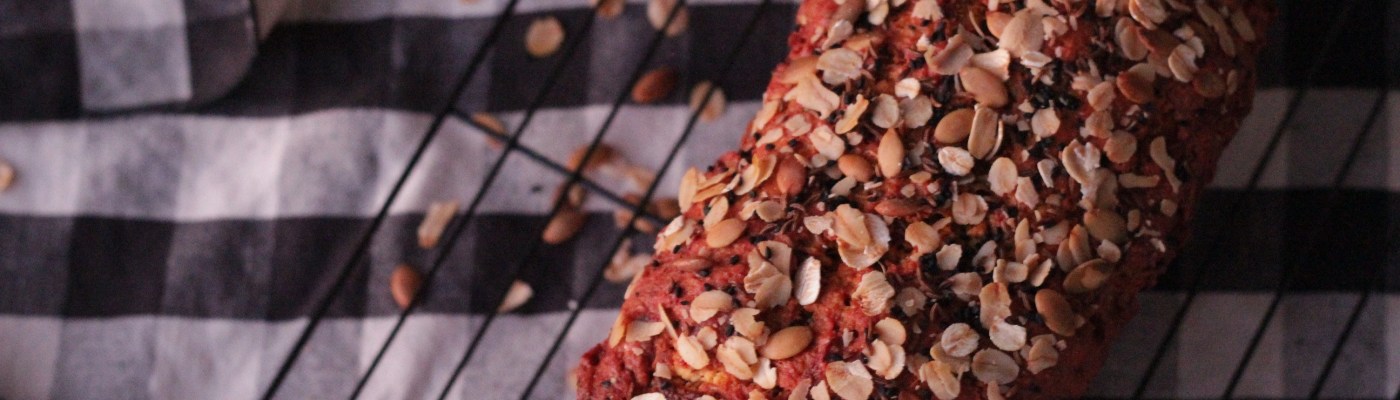
Seeded beetroot and goat cheese bread (pictured above)
So I haven’t adapted this one but I’m not calling it ‘Beetroot and Caraway Bread’ like Ottolenghi does, because it has the same quantity of nigella seeds as it does caraway seeds. Go figure.
Semantics aside, the seeded topping also incorporates pepitas and oats, which all provide glorious crunch. The bulk of this seed mixture is stirred through the batter where the slow roast allows it to meld into the grated beetroot for an earthy, crumbly savoury bread that needs only a little salted butter (or, of course, our omnipresent Meredith Dairy marinated goat cheese).
Recipe here by Yotam Ottolenghi, courtesy of The Guardian.
Cauliflower cake
This recipe has a cult following among the Chat 10 Looks 3 community, and not without good reason. It’s hearty and herby and tastes better the next day at room temperature, so it’s a good one to present at a picnic or lunch with a ‘here’s one I prepared earlier’ flourish.
I usually bump up the herb content, but really the key to this recipe is using good quality, flavoursome cheese. I’m a fan of grana padano or pecorino, though a good aged cheddar is great, or any combination of these.
Recipe here by Yotam Ottolenghi, courtesy of The Guardian.
Roasted broccoli, chilli and ricotta cake
Every time I make this cake I am taken aback by how fine and moist the crumb is, and how crisp and delightful the crust is. It’s somehow such a refined dish yet so rustic and hearty at the same time. Whatever your tastes, its a winner.
I like to roast the broccoli on high so it gets a bit charry. The recipe also calls for infusing olive oil with garlic and chilli before straining off the solids and discarding them; I usually chop them fine and then simply include them in the batter — less waste and more flavour. I’ve also on occasion substituted different cheeses/dairy products in varying combinations (Greek yoghurt, feta, goat cheese) all with delightful results so it’s a good one to work with whatever you normally have on hand.
Recipe here by Helen Goh, courtesy of Good Food.
Polenta, spinach and cheese loaf
I’m not going to lie, when I make this the cheese I opt for is pretty much always grated haloumi (have you recognised a pattern?). It works beautifully to bind the loaf and add salt. But a combination of cheeses also works well, such as crumbled feta, or grated pecorino or cheddar. It’s a classic spinach-and-cheese combo, with the polenta adding delicious moistness and body that makes this loaf incredibly moreish. I usually eat this one within minutes of turning it out from the tin.
Recipe below, courtesy of my mum.
Ingredients:
- 100g polenta
- 80g plain flour
- 1 tbs baking powder
- 1½ tsp salt
- ½ tsp freshly ground black pepper
- 180g baby spinach, roughly chopped
- 3 eggs (size large), lightly beaten
- 100mL milk
- 130mL canola oil
- 250g cheese, grated or crumbled (e.g. haloumi, Greek feta, pecorino, cheddar)
Method:
- Preheat oven to 180° fan forced (200° conventional heat).
- Add all dry ingredients into a large bowl and whisk briefly to combine.
- Mix eggs, milk and oil in another (smaller) bowl and whisk to combine.
- Pour wet mixture into dry mixture and whisk briefly to combine.
- Add chopped spinach and grated cheese to batter, mixing well with a wooden spoon or firm spatula.
- Brush or spray two 500g non-stick loaf tins with oil, and pour batter in, dividing evenly between the two tins. Use a spatula to lightly smooth the tops.
- Bake for 40-50 min until a skewer inserted into the centre comes out clean. Allow to cool in tins for 5 minutes before turning loaves out onto wire rack to cool completely.
 The Foodiarist
Lovely read.
Thanks for the recipes
LikeLike
[…] up into 4 or 5 servings for a work week’s worth of lunchtime meals. This is also likely where my love for a good savoury loaf really took off, as I began to dabble more in savoury baking and exploring meals I could bake in […]
LikeLike
[…] and that boon of the wellness movement, kale. Although I don’t usually love kale (except in a kale and feta loaf), come winter my local farm box company has offerings for green, black and red kale, so I decided […]
LikeLike
[…] is, in fact, sad, because I adore the atypical ice cream flavours. You already know that I prefer savoury to sweet, so much so that when it comes to dessert I’m notorious amongst my family and friends for […]
LikeLike
[…] few years, ever since discovering his recipe for a Kale and Feta bread. This bread is now one of my staple savoury bakes and is—to this day—one of the very few ways I will consent to eat […]
LikeLike
[…] is no doubt that I’m a savoury tooth, not sweet, so the banana bread urges could be repressed and my ‘something sweet’ needs could be […]
LikeLike