Episode 1: in which our heroine procures the pomelo
We were gifted a pomelo this week by one of my husband’s closest friends, whose mother has a tree.
I was thrilled! I’ve never even seen a pomelo outside the mythical universe that is the Masterchef Open Pantry. Most people, I imagine, would respond by cutting it and eating it. End scene.
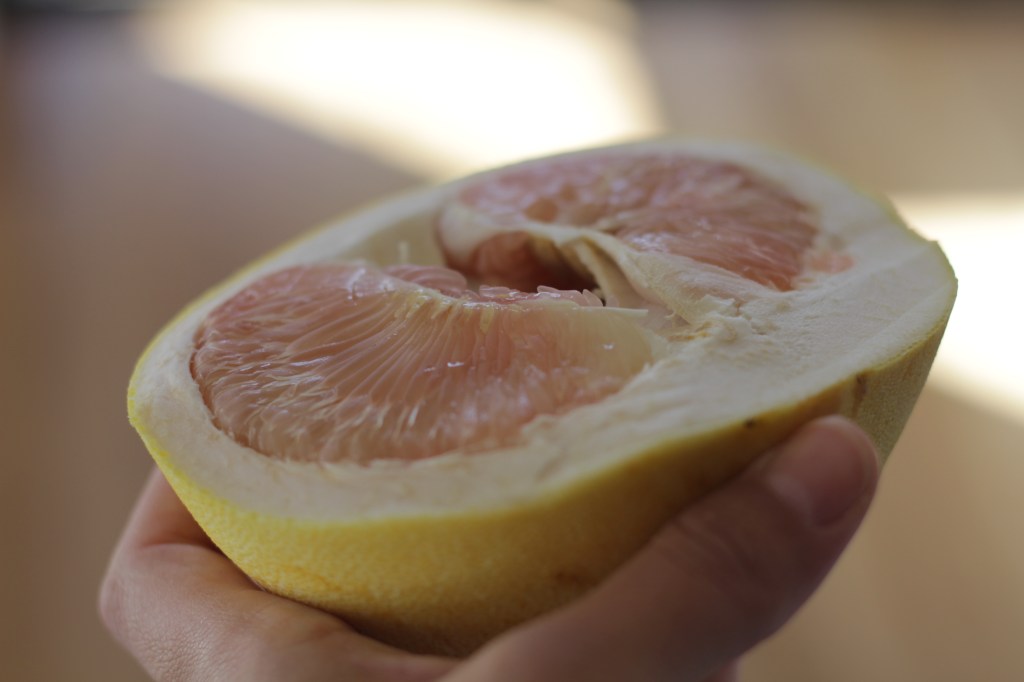
I, on the other hand, was determined to bake with it. I promptly set about googling recipes, finding such mediocre ideas as candied pomelo rind and pomelo bars. But then, I struck gold (or pink, as it were) with Thalia Ho’s recipe for rose and pomelo tarts with burnt honey meringue, from her blog Butter & Brioche.
I’ve always been a sucker for a citrus meringue tart. Lemon is easily my favourite, having requested my food photographer and recipe developer sister, Salma of The Polka Dotter, gift me a lemon meringue pie recipe for my 30th birthday (which you can find here). That being said, I haven’t actually ever had to bake her recipe because she always does it for me. A pomelo bigger than my 9-month-old son’s head seemed like a great reason to attempt her recipe for the first time. Taking on board the flavour inspiration from Thalia, I pulled out my trusty recipe cards and set to work.
Episode 2: in which our heroine fails to juice the pomelo
Salma’s recipe calls for 200mL of juice. Do you know how much juice one pomelo yields? No, neither do I. The bigger question, though, is do you know how to juice a pomelo?
Being triple the size of my hand I wasn’t confident I could hold half of the pomelo over my citrus reamer let alone squeeze it. Could I squeeze it in quarters? Should I extract each segment? Google has the answer!
Google says: use a juicer.
I do, in fact, own a juicer. It’s one of many Kenwood stand mixer attachments gifted to me for my wedding along with the stand mixer itself. The juicing attachment has never been used. I’m not really a juice-kinda-lady. A pomelo bigger than my 9-month-old son’s head seemed like a great reason to use the juicer for the first time. The juicer was pulled out, instruction manuals were extracted and skimmed, and I set the stand mixer with juicer proudly on my kitchen island bench for juicing first thing in the morning. I went to bed giddy.
Spoiler alert: The giddiness did not last.
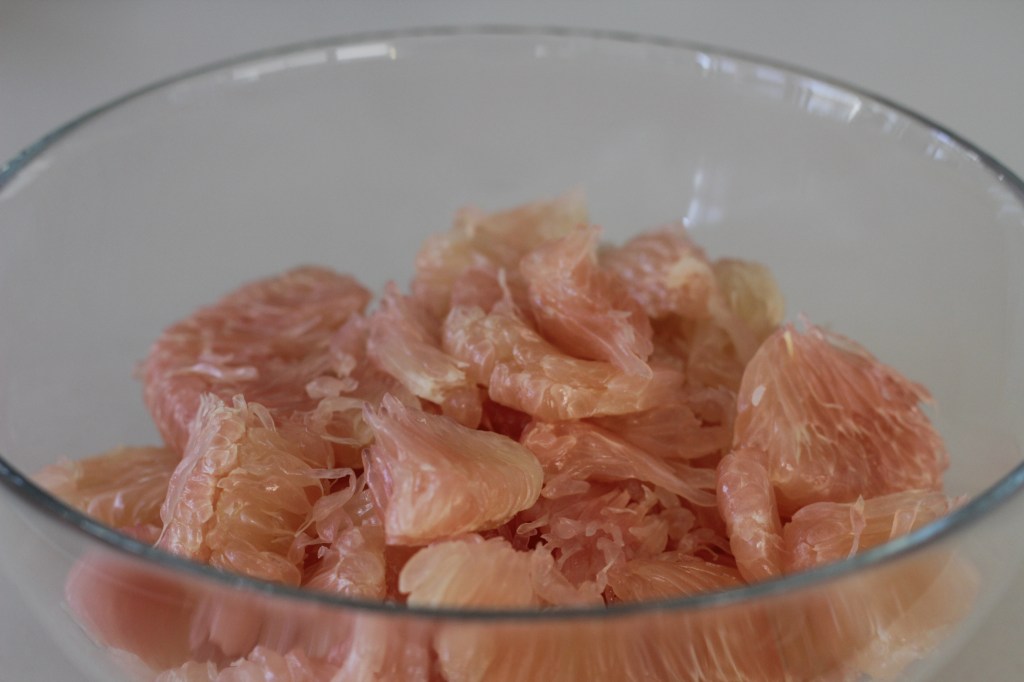
Peeling the pomelo, I was delighted to discover the beautiful blush pink hue of the flesh belied by the thick chartreuse skin. I held each piece up to the light like a jeweller, admiring the graduated colours, the glossiness, the plumpness. I became obsessed with trying to peel each segment whole, like mandarin pieces, so I could ogle them in a neat row. The flesh pulled apart easily, being surprisingly dry and only bursting with flavour when each little kernel was squished between my tongue and palate. This should have been my first warning sign. I’m sure you can guess, it was not.

Pomelo peeled (and photographed), I popped it into the juicer. Handful by handful I fed the gorgeous pink shreds into the tube and was rewarded with a scant 60mL of juice. From a pomelo bigger than my 9-month-old son’s head. Peering into the pulp collector I found the source of the problem. The skin of the flesh was proving too tough, and the juicer was merely separating the segments into the individual juice sacs, flinging them whole out the waste chute like wood chips. Now what?
I pulled out the juicer’s manual again. It recommended using the dedicated citrus juicer attachment instead. Which I also own, believe it not. TOO LATE MR KENWOOD.
Therein followed a movie-style montage of juicing attempts through all available means. This included:
- a potato ricer (holes too big), yielded 20mL of lumpy pomelo juice
- a garlic press (smelt like garlic), yielded 5mL of garlic infused pomelo juice
- a smoothie blender attachment for my stand mixer (not enough liquid to pulverize fully), yielded one clump of mushy pomelo pulp
- and one particularly memorable moment where I simply refed the shredded pulp straight from the waste collector back through the feeding tube of the juicer. While the waste collector was still in my hand. Yielded 0mL.
Episode 3: in which our heroine inexpertly applies food colouring, to the detriment of the pomelo
After cleaning pomelo pulp off the floor, I eventually settled for pressing every squidge of pulp repeatedly through a fine metal colander. (Oh alright, I tried a regular plastic sieve first ok? It yielded 10mL and a sore wrist.) Six implements later, I held 240mL of fragrant pink juice in my Pyrex measuring jug.
Now that I finally knew I had the requisite juice for one full recipe, I could make my shortcrust pastry in peace. I did not make it in peace, let’s be honest. The food processor made my son cry, the dough was too sticky and I rolled it wrong. But this story is not about our shortcrust pastry, it’s about our pomelo.
With my shortcrust pastry ‘dry and pale golden’ and cooling gently in its fluted tin, I turned my attention to my pomelo rose curd filling. Butter & Brioche calls for using pink pomelo juice and adding pink food colouring halfway through the process if deemed necessary. With the colour of my pomelo being so utterly, perfectly pink, I deemed the colouring unnecessary. Who needs artificial colours anyway?
Cook juice and rind over low heat while whisking gently. Continue whisking and add cornflour, then sugar, then egg yolks, then butter until combined and the filling is deep golden yellow. Then bring to the boil and… Whoops, we’re making pomelo curd. So the filling should be pink.
Wait, but egg yolks are deep golden yellow. And butter is yellow.
My pomelo curd was now orange. Not a pleasant orange either. A weird lumpy orange. Attempting to ‘still whisk gently’ as I ran to the pantry, I dug out the only pink food colouring I could find — a powder. (Still whisking! Gently!) I stuck a toothpick in the powder and colour tested it in some water. Perfect! Add a few flecks to my curd. Phew. My whisking became less frantic.
Fun fact: food colouring gets darker over time. I can only assume that bringing it to boil did nothing to slow down this process. Like watching Alice eat from the wrong side of the mushroom, I whisked in horror as my curd turned from a gentle blush… to stale musk stick… to vibrant coral… before finally settling into the eye-watering shade of Barbie’s lipstick. Except it wasn’t settling; my now thick curd was somehow still boiling, even off the heat, glooping explosively. I scraped it out of the hot saucepan into a bowl, wiped my brow, and took a breath.
I did not have “unashamedly feminine” rose pomelo curd filling as Thalia Ho had promised. I had a congealed fuchsia paste with highlights of brown (burnt curd), orange (unmixed egg yolk) and white (I can only assume unmixed, errant egg white). But it was a pourable congealed fuchsia paste, and it tasted like rose and pomelo… so the multicoloured lumps were picked out, and into the tart shells it went.
Episode 4: in which our heroine marries the pomelo with honey meringue and all is right with the world
A night in the fridge did nothing to deter the food colouring, but with the trauma of the colour change behind me, I was feeling good about the final step: burnt honey meringue. I was prepared too! Boutique small batch honey in a jar, egg whites carefully reserved and picked clean of any threatening impurities. I even had a blowtorch for browning the meringue! I had planned to buy a kitchen blowtorch but my husband insisted he had a ‘small’ one. He works on cars in his spare time.
So with the propane tank strapped over my shoulder and my digital thermometer ready, I carefully boiled and burnt my honey at the stove as my egg whites beat alongside me in my Kenwood. My previous (failed) meringue-making attempt was ten years ago, but after watching and reading Salma’s blog, I have grown to understand that whisking meringues invokes a special kind of patience. And not the kind of patience required for sourdough to rise (with which I am well acquainted). For meringues, you have to be on hand watching, but still be able take it slow. Pouring the gentlest stream of bubbly, hot honey into the egg whites felt practically artful, as tiny golden droplets were whisked skywards, rimming the glossy whites in a sticky crown.
Several days later… my egg whites were a softly burnished gold, glossy, and held stiff peaks.
Don’t be fooled by those ‘watching this cake decorating is so satisfying’ YouTube videos; piping meringue is not straightforward. I tend to bake the kinds of things that don’t require decorating beyond a sprinkle of salt flakes, pearl sugar, crushed nuts, or dried flower petals. The skills required for sprinkling do not translate well to piping. Nevertheless, the Barbie curd was now mostly obscured. I would just tell my guests not to look directly at the tart. Like an eclipse.
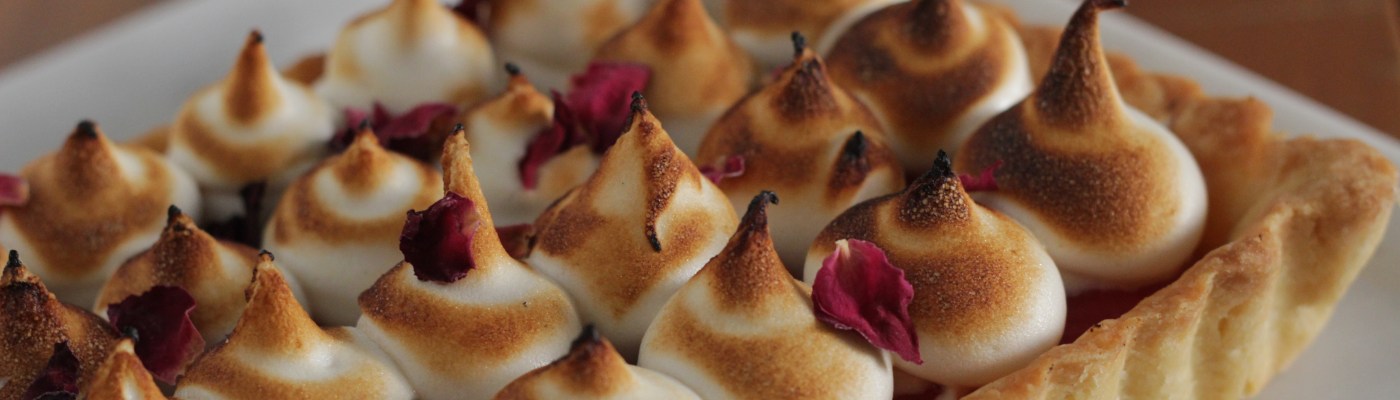
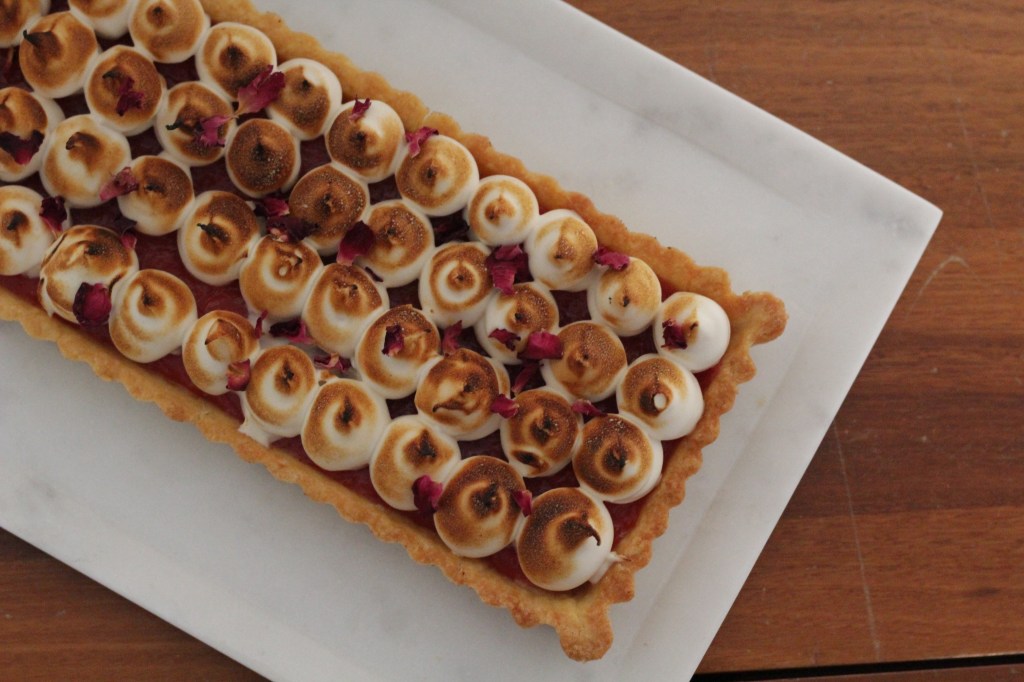
Lucky for me, my husband’s propane tank was there to assist. Safety goggles on, I turned on the torch. From a metre away each little meringue peak sparked and sighed, browning and bubbling like marshmallows on a campfire. Is there anything better than the smell of burning sugar? And the sight of it! The vivid pink curd now peeked out mischievously beneath dark golden plumes, hinting at the tart’s intense flavour rather than exposing my heavy handedness.
My sprinkling skills were also not to be wasted. With a salt-bae whip of vibrant rose petals, my Pomelo and Rose Tart with Burnt Honey Meringue was complete.
And it actually tasted… perfect. The bitterness of the pomelo rind paired beautifully with the vibrancy of the juice, which was offset by the delicate floral notes of honey and rose. The buttery pastry crumbled moreishly on the tongue, while the meringue was like silken sugar, pillows of sweetness against a bed of jammy pomelo curd, lumps entirely undetectable.
Epilogue
My recipe made WAY more meringue than could possibly be needed to top my tart. So I decided to try another The Polka Dotter classic and bake some meringue kisses.
This did not go as planned.
My meringues were sticky and my sleep-deprived brain (I have a 9-month-old, remember?) forgot to convert Fahrenheit to Celsius so instead of meringues of burnt honey, I made honey meringues that were, well, burnt. But in the form of meringue, the burnt honey flavour was bitter in an addictive way that calls to be paired with softness and sweetness. I obliged by serving them with orange blossom whipped cream, juicy blood oranges, and crushed pistachios in a form of Middle Eastern-inspired Eton Mess. And a little bit of gold dust never hurt.


Yum Yum!
LikeLike
[…] Pumpkins. Homemade jam. Quail eggs. Freshly caught seafood. Pomelos. (Remember The Pomelo?!) […]
LikeLike