
Jump to recipes (Banana and date bread with tahini, and Iso avo bagel)
It is no revelation to say that I like food. Really really like food.
Not only do I spend a large proportion of my time dreaming about, cooking, recipe developing for, and, of course, consuming food, I also read and write a lot about food. Food gives us energy, and it is safe to say that I expend a fair chunk of that energy by pouring it back into food.
I consider myself a fairly adventurous eater, and the list of things I won’t eat is pretty small. Barring some religious exclusions like alcohol, pork, and other meat that isn’t halal—along with some of the more incidental omissions like offal and obscure seafood that don’t cross my path often—I’m willing to try most foodstuffs.
But it certainly wasn’t always the case. I have previously written about, sadly, how it took me many long years to appreciate olives.
Growing up, there were actually several everyday foods I just couldn’t get on board with. The most prominent on list, aside from olives, included: avocado, mango, raw tomato, pawpaw or papaya, and banana.
Some of these dislikes were genuine (avocado and banana: it was the slimy, squishy mouthfeel I struggled with); some were a result of experience (tomato: after I put the wrong type on a sandwich one day, the flavours and textures didn’t blend, and I was scarred for 20 odd years); yet others were were entirely inscrutable (mango: don’t ask, I don’t get it either); or even learned from my older sister (pawpaw: as a young child she would scream and run from the kitchen to escape the smell).
At first
As a child, it’s not at all hard to be a picky eater.
It’s quite ‘acceptable’—sometimes even more so than a child who ‘eats everything’ who is commonly treated with suspicion (“Surely, not everything?”) or smug disregard (“You wait! It’ll change as they get older!”). Parents, non-parents and restaurant menu-developers alike assume that children have a narrower field of consumption and opt for blander tastes and fewer ingredients.
Unsurprisingly, it was easy for me to cruise through childhood and adolescence ordering burgers ‘with no tomato please’ and pizzas ‘without the olives’, yet still identifying as a rambunctious, eager foodie.
Being the foodie that I was, as I moved into my post-school, uni (that’s ‘college’ or ‘university’ for you international folk) days, I developed a love for the Aussie breakfast scene. Some people move past this phase, like they do their clubbing and partying years, I imagine. But for me the infatuation has only grown, to the point that, nearly 6 years ago, I planned my our wedding reception as a brunch party. We had mini bagels, corn fritters, individual pots of toasted muesli layered with fruit and yoghurt, freshly baked scones, and the unforgettable Haloumi Bar. We gave out baggies of loose-leaf tea as our bonbonniere. My night owl husband was not enthused, but I won him over with a barista-run coffee cart and Nutella cronuts. I have no regrets.
I am not of the Nutella cronut School of Breakfast. I prefer the bubble-and-squeak potato hash cakes. The haloumi stacks. The Turkish eggs with labne and za’atar. The bagels stuffed with grilled veg and bitter greens and melty cheese. The granola served alongside yoghurt panna cotta topped with berry compote. The brioche French toast with griddled fruit, drizzled with maple syrup spiked with herbs.
My mouth is watering as I type.
You might have noticed though, that I omitted two of the most ubiquitous Australian all day breakfast menu items: smashed avo(cado) on toast and banana bread.
Because when I first started breakfasting, I did not like either of them.
Initially, my aversions were manageable: I simply ordered other items. Regardless of whether I was in the mood for sweet or savoury, I could always enjoy the other options. Any time my breakfast companions ordered the avo toast or banana bread I inwardly rolled my eyes. Why would you go out for breakfast and order avocado on toast? Surely, if you wanted to eat it, you would make at home?
Eventually though, these grew to become the elephant at my table.
The first thought
As the Australian all day breakfast menu really burgeoned, and as cafes got more adventurous, I could no longer ignore the undeniable appeal of something so simple, elevated in fascinating new ways.
Avocado paired with beetroot relish and a crumble of goat cheese. Mashed and swirled with hummus and finished with wafers of vibrant pink radish and a squeeze of lemon. Or topped with a smattering of dukkah and labneh. Or my beloved haloumi.
Banana bread dotted with dark chocolate chunks and roasted pecans. Fragrant with gently warming spices and topped with toasted coconut. Or toasted and browned to caramelised perfection with a schmear of fresh lemon-whipped ricotta. Or honeycomb butter.
Let’s be frank. These are menu items that are pretty hard to go past. Sometimes—especially on a humid Brisbane summer’s day—I longed for the ease of a savoury breakfast that didn’t involve eggs, something fried, or anything hot at all. On occasion I wanted something sweet to finish but house-made and artisan crumpets were not yet the pervasive feature they are today.
There is no doubt that I’m a savoury tooth, not sweet, so the banana bread urges could be repressed and my ‘something sweet’ needs could be met with drinks or other baked goods. But as I moved into early adulthood one thing had become clear to me: I wanted to learn to like to avocado.
The first taste
For the Avocado Despisers among you, you’ll appreciate immediately that avocado on toast is very confronting. There is nowhere to hide from all that green (or yellow, depending on your variety and preference for ripeness).
I also grew up in a household where a common staple during peak avocado season was to puree the flesh with some milk and sugar, and to eat it with a spoon as a sort of pudding. Once again, there was just so much green.
I decided to start with much less offensive amounts of avocado—’tiny tastes’, if you will—in foods where I could almost pretend they weren’t there. A sliver in a tempura prawn sushi roll. A spoonful mixed with lime and herbs and buried under beans, sour cream and melty cheese in a Mexican tortilla.
I slowly progressed to adding it to dishes in larger amounts. A slice or two hidden amongst other veggies in a grilled Turkish sandwich. Small pieces chopped into one of my mum’s favourite dinnertime side salads.
I sadly don’t even recall the first time I ordered avocado on toast myself, and heartbreakingly don’t even remember the first time I took a bite of one.
What I can tell you, is that it is now—without a doubt—my favourite breakfast menu item.
I’ve ordered it with the beetroot relish, the hummus, the labneh, the dukkah. I’ve ordered it with slow-roasted tomatoes and balsamic-macerated strawberries. I’ve ordered it with and without haloumi.
And I love them all.
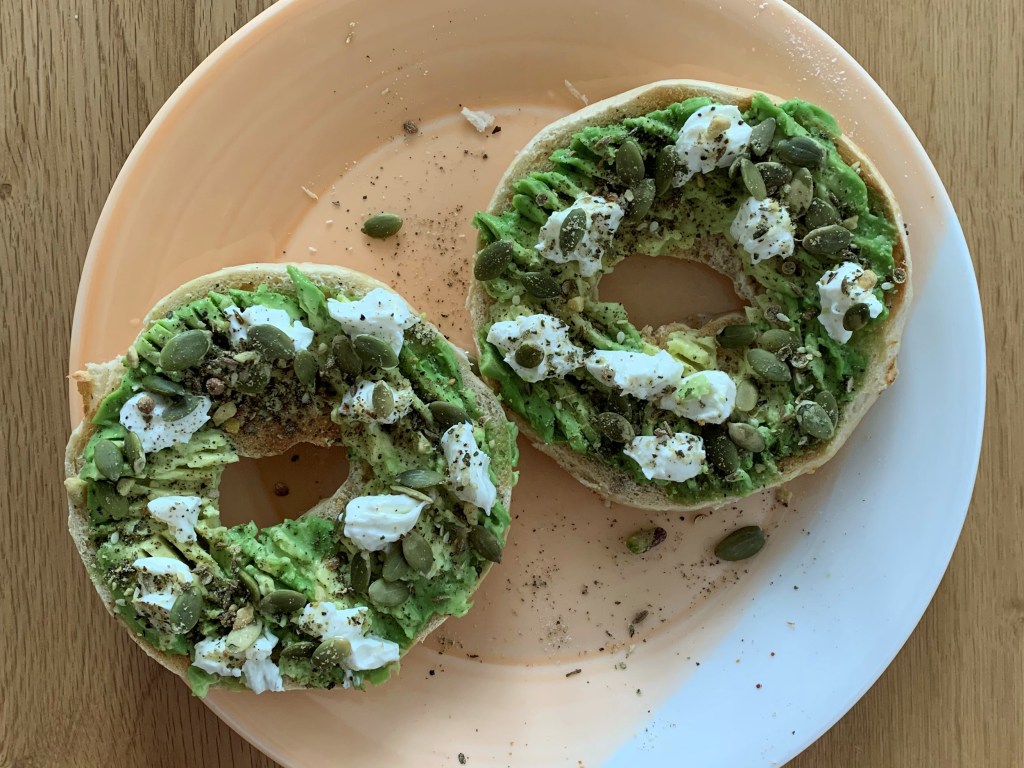
In my son’s collection of handwritten family recipes that I’ve started collating for him, I even decided to include a ‘recipe’ (see below) for smashed avocado bagels, given the pivotal role it played for me and for him during my maternity leave, picnicking at home in our backyard daily during COVID-19-induced lockdowns and social isolation.
I will say, that wanting to like avocado was key to my success in learning to like it. But it is definitely not an essential element; sometimes all you need is a gateway.
My banana bread journey was much shorter and much less calculated, given that it was almost entirely an accident.
Postnatally, I was gifted a loaf of chocolate chip banana ‘cake’ by a well-meaning visiting friend. I ate a slice in her presence to be polite, only to find that choc chips were, in fact, my banana-baked-good gateway. I proceeded to eat the rest of the cake by myself over the next two days (hey, a breastfeeding mum needs fuel).
Shortly after, when Tieghan Gerard of Half-Baked Harvest re-shared in my Instagram feed her recipe for banana bread which calls for caramelising the bananas first, I was wooed. I took the gift of homegrown bananas from my parents’ backyard, waited until they turned black, and then cranked the oven to roast those babies. It helped that Tieghan’s recipe also calls for chocolate chunks.
But I tried a couple more recipes, slowly moving on to chocolate-free ones, and even developed my own recipe (see below) that has the sweet, caramelly richness of fat Medjool dates, and is mellowed by the nuttiness of tahini.
The firstborn
Around the same time, we began thinking about introducing solid foods to our (now-2-year-old) bub, and the way I thought about food started to shift again.
I had reached a point in my life (and my marriage) where I was relatively unapologetic about what I chose to cook—cooking to please myself and my tastes only. At the time I was the only chef in our household (my husband detested cooking) so while I always deferred to his lactose intolerance, I had stopped avoiding nuts in rice and fresh fruit in salads and dried fruit in stews, and any of his other preferences I couldn’t understand. Unless he was going to start to cook, he would just have to learn to like it (spoiler alert: he did. Both start to cook and learn to like the food I made).
So I now became anxious that catering for a few-month-old baby would mean, once again, having to change the way I cooked.
Other parents will have no doubt gone through the same experience—agonising over which foods to serve, which are ok for babies, which aren’t, when to introduce the very first taste, what it should be, should food be pureed, what consistency should puree be, oh my God I don’t want to spend my days pureeing food, wait what’s ‘baby led weaning?’, and so on and so forth.
The #babyledweaning and #feedingtoddlers crowds are vocal and confusing and overwhelming, and not always supported by evidence-based advice.
One concept that did come up and caught my attention is the idea of ‘learning to like it’. The theory behind this is that, as part of modelling a healthy relationship with food to your children, when confronted with a food that normally makes you pucker your mouth, screw up your nose and vehemently shudder your head back and forth as you try not to retch, you would instead politely decline and tell your child that you don’t want any of that food because you are still “learning to like it”.
While there’s a part of me that thinks this façade is somewhat ridiculous and we should just be honest with our children, the actual idea of ‘learning to like’ a food struck a chord with me now because—aside from personally experiencing it—I had stumbled upon the theory and research behind it in previously my childless life, when reading Bee Wilson’s seminal (seminal to me, anyway) work First Bite: How we learn to eat.
I’ve referenced Bee’s work a few times before because I was so taken with it. If you don’t have time for the full 400-odd-pages, I can recommend you listen to her interview on the 2016 Gastropod episode. In it, Bee talks about the fact that many individuals believe—or want to believe—their tastes and preferences are set in stone by the time they’re adults: you have a sweet tooth; you hate brussels sprouts; you eat olives like candy; seafood has a weird texture. And while studies have shown there is a very limited opportunity or ‘flavour window‘ during a baby’s life in which they can be exposed to strong and unique flavours to help broaden their horizons… we can and do, in fact, continue to develop our tastes throughout our lives.
Bee talks about how tastes are influenced by social factors, culture, context, exposure, memory, and parenting, despite the fact that they may be genetically predisposed in a certain direction. For me, exposure, is the one that stood out the most. Many parents have heard that it can take 20 exposures to a food before a baby or toddler will be willing to actually place any in their mouth, and Bee delves wonderfully (in both her book and the podcast interview) into the concept of ‘tiny tastes’ to help fussy eaters.
But this concept is not limited to toddlers. First Bite is not a book about feeding babies and young children, it is a book fundamentally about how human beings discover, explore and learn to eat food—from birth and on into adulthood. And it aligns perfectly with my own experiences of learning to like foods I thought were forever lost to me. Repeated exposure, cultural importance, seeing others enjoy the food, experimenting with the texture and way the food was prepared… all of these things and more helped me learn to like (actually, love) avocado and banana bread. I even ended up eating pawpaw one morning when out breakfasting with my little one; the granola with panna cotta was served with ‘seasonal fruits’ which turned out to include pawpaw, and in my new goal of trying not to unreasonably refuse foods in front of my one-year-old, I just ate it—and was surprised to find I enjoyed it! Under this same umbrella, I started eating mango more often, now relishing it regularly in summer with thick Greek yoghurt for a balanced afternoon snack or morning tea.
I do appreciate that not everyone falls into this boat. At the end of the day, individuals still have the tastebuds they have, and will continue to have certain reactions to specific tastes and flavours—coriander (cilantro) being an excellent example that has scientific, genetic basis for why some people simply think it tastes like soap. My sister is one of these people. My dad, while adores coriander, absolutely loathes the smell and taste of garlic (it’s tragic, I know). My mother struggles to enjoy eggs. A good friend of mine loves the smell of coffee and desperately wants to be able to enjoy drinking it. When we breakfast together every few months, if I receive a particularly well-balanced, mild-roasted, and all-round delectable coffee, I offer her a sip (well, I used to, pre-COVID). To this day, after 12 years of friendship and sips, she cannot bring herself to like it.
To finish
I now consider my own palate genuinely well-rounded, and try not to unreasonably refuse to taste something. The more I read about the evidence-based way to raise a child who is a ‘competent eater‘, the more I see that role modelling is key: modelling enjoying food and cooking, eating a rich and varied diet, listening to internal hunger cues, practicing ‘food neutrality’ (i.e. no food is inherently ‘healthy’ or ‘unhealthy’, ‘good’ or ‘bad’, but all foods have a place if you listen to how your body feels when and after you eat it. This could be whole other blog post though so I won’t go into more detail here).
I try to eat a wide variety of foods and serve them to our now-2-year-old, and continue to let him see us (or at least me) enjoying them without any pressure for him to do the same. Even if he keeps turning his nose up at a food (like sliced cheddar cheese. Go figure), I continue to offer it to him because if I don’t, well, how will ever learn to eat it, and potentially like it? I try to practice my best poker face when he’s eating and not wait with bated breath while he tries something that’s a particular favourite of mine or something I’ve spent hours cooking… but my heart does a happy dance when he asks for more. And let’s be honest, my poker face isn’t very good.
Avocado was our bub’s very first food, and to this day he happily eats it smushed on grain or sourdough toast—or a bagel of course—with a dusting of whatever dukkah we have in the fridge. Olive and haloumi loaf was not far behind in his first foods, with us offering it to him before he turned 6 months old, and we now routinely order extra haloumi when out to breakfast, to account for the fact that he pinches my #haloumiontheside without missing a beat.
Like many toddlers, he absolutely adores mango and will eat a whole one within a few minutes, and the same goes for pawpaw, papaya and basically any fruit. He simply devours raw tomato. As the weather started to warm up this summer, we took to sending quartered cherry (or any other small) tomatoes in his daycare bento box as a snack.
This is fascinating to me because, as you may recall, one of my ‘learning to like it’ foods listed at the start of this story, was raw tomato. While I have always enjoyed a tomato-based curry or rich Italian sauce (hello, lasagne!); I happily munch on sun-dried tomatoes alone or stirred through pasta or basically any other way; and I love a good slow-roasted, balsamic-drizzled tomato as a side for breakfast… raw tomatoes are still a No Go for me.
Or, they were until just the other day…
While chopping the snacking tomatoes for our toddler one evening, not long before Christmas, I couldn’t help but notice that the aroma wafting up towards me was… mouth-watering. Peppery and rich and sweet. Our little one was eating the tomatoes almost as fast as I could cut them, but I managed to nab one before he could gobble it up, and I stood there, wavering for a moment, tomato-quarter poised, my husband agape, and I then I took the leap.
I ate raw tomato willingly for the first time in a couple of decades.
And I loved it. Being midsummer here in Australia, it tasted just as it smelt: sweet, peppery, rich. Delicious. There is nothing like enjoying fresh produce at the height of its season, and, making the most of summer, I have been munching on raw tomatoes ever since.
I’ve been popping them on salads, adding them to stuffed bagels, even adding them to cheese toasties (that’s Grilled Cheese, for the Americans), which heretofore I would have considered blasphemous. Why ruin a good cheese toastie, after all? But ruin many a cheese toastie I have been, and thoroughly loving the sweet juiciness and depth of flavour it adds.
My toddler, on the other hand, was unimpressed when I presented him a cheese and tomato toastie.
“Don’t want it.”
He just wanted cheese on his. It turns out, my toddler only enjoys tomato fresh, not cooked or heated because it ends up “squishy”.
I guess he’s still learning to like it.
Recipes
Banana and date bread with tahini

This recipe is written for one average sized banana, and developed so it easily scales up for however many bananas you have to use up (or how much you want to make).
This recipe uses a 500g (1lb) loaf tin for one banana; mine measures approximately 20cm x 10cm x 6.5cm. For 2 bananas I split the batter across 2 x 500g tins, and for 3 bananas I size up to one 1kg (2lb) loaf tin measuring approximately 24.5cm x 14.5cm x 7cm, and bake it for longer.
Ingredients
- 1 overripe banana (approx. 100g banana mash after peeling)
- 80g pitted dates (medjool are best)
- 3tsp (15mL) lemon juice
- 75g plain flour
- 25g wholemeal flour
- 1/2 tsp bicarb soda (baking soda)
- 1/2 tsp salt
- 1 egg (Australian size ‘large’)
- 40g light olive oil
- 85g thick Greek yoghurt
- 30g walnuts, roughly chopped or broken
- Optional: runny tahini, sesame halva, black and white sesame seeds, demerara sugar
Method
- Roughly chop the pitted dates into a small heatproof jug or bowl. Cover with freshly boiled water and leave to soak for approx. 20 minutes.
- Preheat the oven to 140°C (fan forced).
- Brush a 500g loaf tin on the base and up the sides with tahini. If you don’t have or aren’t using tahini, you can either brush it with well-softened butter, or line it with baking paper.
- Peel the banana and tip the flesh into a small bowl, and mash it roughly with a fork. Add the lemon juice and mix.
- Once the dates have softened, strain off the water slowly, trying not to lose any flesh or dregs, and squash the dates a little with a fork to remove as much water as possible. If you’re using prepackaged dried dates it’s not a big deal to leave a little extra water, as they tend to be less juicy than the fat medjool dates.
- Tip the dates into the banana mash and mix well with your fork. Set aside.
- In a large bowl, combine the 2 flours, bicarb soda and salt, and give it a quick whisk.
- Break or chop the walnuts and drop them into the flour and give the bowl a little bit of a toss to coat the nuts in the flour mix. Set aside.
- In a medium bowl, crack the egg and whisk lightly. Then add the olive oil and yoghurt, and whisk well to combine.
- Set aside the whisk and switch to a spatula or flattish spoon. Tip the banana mixture into the wet ingredients and stir lightly to combine.
- Pour the wet mixture into the dry mixture in 3-4 batches, folding or gently mixing well each time to ensure you don’t get lumps and there are no pockets of dry flour remaining. Don’t overmix.
- Once the batter is mixed, pour half the mixture into your prepared loaf tin. Drizzle 1-2 tablespoons of tahini and/or crumble some halva on top. (Or skip this step if you’re not using tahini or halva, and simply pour all of the batter in).
- Pour the remaining batter into the tin.
- To finish, on the top of the loaf, drizzle another 1-2 tablespoons of tahini, scatter some mixed sesame seeds, and sprinkle 1-1.5 teaspoons of demerara sugar (for crunch!).
- Bake for approximately 1 hour and 20-25 minutes until a skewer comes out clean. You can also gently press a fingertip in the centre of the loaf and listen carefully for any soft ‘crackling’ that sounds like raw batter. If so, return to the oven in 5 minute increments until the loaf is fully cooked through, and the centre of the loaf springs back to touch.
- Remove from the oven and rest in the tin for 10 minutes, before loosening the edges gently with a thin heatproof spatula or knife, then tipping onto a cooling rack.
- Serve while still slightly warm or toast fat slices in a pan, with a schmear of fresh ricotta or butter drizzled with honey.
Iso avo bagel
Ingredients
- 1 x bagel of your choice (I like everything or garlic)
- 2-3 tbs hummus
- 1 small, ripe avocado (I like Hass)
- 1-2 tsp dukkah (any variety)
- soft goat cheese (if you live in Australia, I highly recommend Meredith Dairy marinated goat cheese in oil. If you’re not a goat cheese fan, soft feta is a great alternative)
- 1-2 tsp pepitas (pumpkin seeds)
- salt and pepper
Method
- Slice the bagel in half across the width, so you have two flat rings. Toast to your preferred level of toastiness.
- Spread the hummus across both halves.
- Cut your avocado in half, remove the pit, and slice, dice or mash as you wish. Tip the avocado onto the bagel halves and mash lightly with a fork (if not already mashed).
- Give both halves a sprinkling or grinding of salt to your taste.
- Sprinkle the dukkah evenly over the avocado.
- Crumble, tear or squish thumbnail-sized bites of goat cheese and dollop these on top. Put as much or as little as you wish.
- Scatter the pepitas over the top, and finish with a fresh grinding of black pepper.
- Enjoy!
 The Foodiarist