
New to my spanakopita series? Catch up on the story so far here.
***
At this point in my Spanakopita Test Kitchen journey, I was losing enthusiasm. I was still keen, however, to make my own phyllo.
I had looked at Peter G’s recipe for authentic spanakopita complete with homemade phyllo and his blog post showed his mother rolling bedlinen-sized sheets of dough so thin you could read through it, using a rolling pin that looks like the remarkably-long-poking-device from an early Friends episode (read: obscenely long and thin), before carefully rolling up logs of pie that curl into a silver tapsi for baking.
I am not a Greek yiayia, do not own said rolling pin or a tapsi, and figured my chances of rolling phyllo using this method were slim to nil. And after the questionable results from my attempt to follow another pie from Peter’s blog, I was dubious that his recipe would be to my taste or general cooking style.
I had, however, also stumbled upon another recipe for homemade phyllo that called for machine-rolling strips using a pasta roller—which sounded infinitely more manageable and like it had a reasonable chance of success. And the recipe was from George Calombaris, no less, so another reliably authentic Greek source.
I settled on George’s phyllo recipe, then a filling recipe from what Yotam Ottolenghi and Sami Tamimi, authors of Jerusalem, call ‘Herb pie‘ yet sounds suspiciously like spanakopita. This filling included ample herbs (obviously, with that name) and swiss chard (‘silverbeet’ here in Australia), plus the chard stems and sliced celery stalks, and even, curiously, rocket. For dairy side of things, their recipe lists feta, and anari (or ricotta) and mature cheddar, with two eggs for binding.
Since I had moved on from following recipes blindly and was hoping to start putting some of my learnings into practice, rather than making the spanakopita in a pie dish, I opted to try my hand at individual coils. Since I would be creating long strips of phyllo using my pasta roller, I noted they would lend themselves to making the long logs that would coil easily. And being a huge fan of individual soft pretzels, bread knots, cinnamon buns and the like, I figured this approach tailored to my tastes quite well.
***
I’m not going to bore you with the full details of this attempt, but suffice to say that the phyllo, while worked remarkably well, was more time-consuming than I had budgeted for, leaving me with less time to focus on the filling.
Yotam and Sami also call for sweating down the onions, spring onions, and greens, which I then once again tried to rid of all liquid before it had any real time to cool.
In my burnt-handed, anxiety-ridden state, desperate to finish 6,459 individual mini scrolls before daycare pickup, I managed to forget the eggs until halfway through shaping, at which point I haphazardly threw one in, hoping the ratio was still on point.
While trying to experiment with the homemade phyllo I started mixing up how many layers to use for each log before coiling it, with some having only one (rolled up back on itself), some having 2 or 4, and some having some indeterminate number that I lost track of while randomising too many variables and controlling for basically none.
Baking times were also a dog’s breakfast, as I had departed from scripture at this point and was winging it entirely based on 100 percent lack of experience with baking homemade phyllo and coils of pie.
The results were, as you can imagine, mixed.
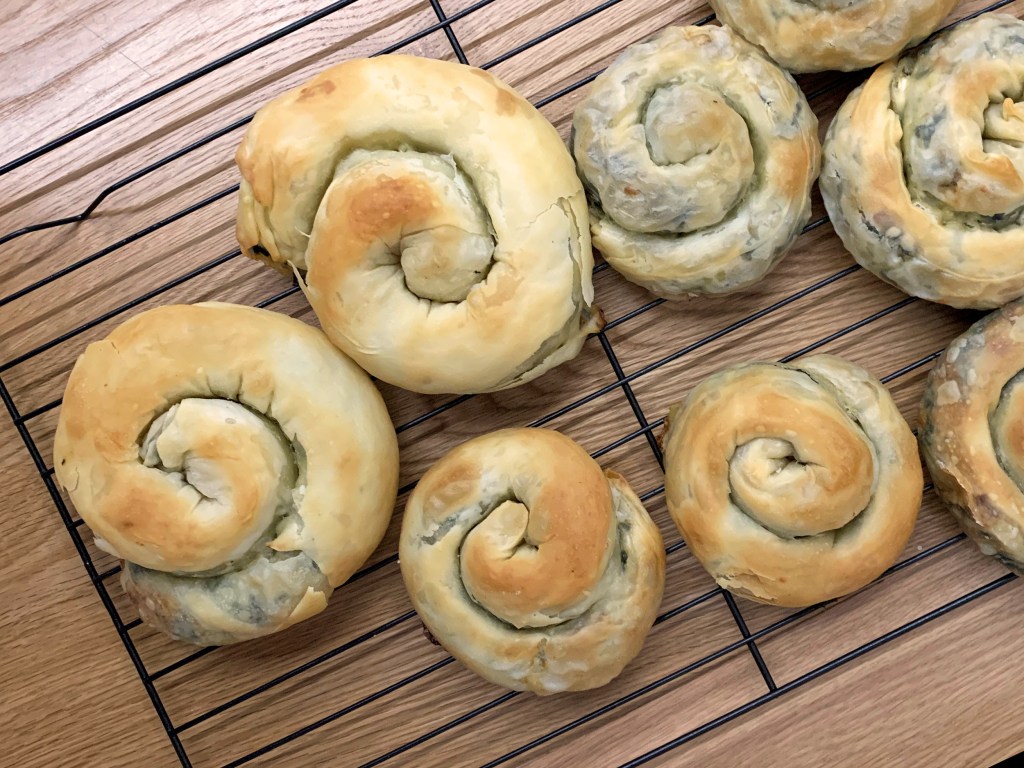
I enjoyed the chunkier texture that resulted from including the silverbeet stems and celery, but I wasn’t necessarily sure the celery added anything in terms of flavour—and the same could be said for the rocket. I had thought I’d enjoy a pie with a higher calling of herbs, but I was surprised to find the flavour ended up muted. The combination of cheeses I used (feta, ricotta in place of anari, and kefalograviera in place of cheddar) generally had a good flavour, but was hard to tell what impact the ricotta had in terms of texture and flavour versus the eggs, as I had lost track of which scrolls had the eggless filling.
The homemade phyllo pastry was by far the biggest success to come out of this test kitchen episode.
It was a dream. In some aspects, the execution was, in fact, a nightmare… but overall the texture was silky and stretchy, it was lovely to work with, layered up beautifully, and tasted spectacular. Using a pasta roller is also very therapeutic when you have the time for it and I looked forward to trying again at another time when I was under less pressure. I learnt very quickly to use an adequate dusting of cornflour on each strip and on my countertop, and started to gauge (despite my stark lack of controlled variables) how much butter or oil to use between layers, how many layers to pull together, and how long to bake the pies for a super golden, crispy crust that was well-cooked through (essentially: not as along as I baked any of these).
***
With the phyllo being such a triumph, I recalled the thrill of tasting the filling after my second attempt, and decided next to combine these efforts. While I still wanted to try the haloumi variation I had earmarked earlier, I decided to first pursue a more authentic result before moving on to further experimentation.
Flushed with success, within a couple of weeks I set about to create a pie that would use the filling recipe from Nagi of RecipeTin Eats, along with George’s phyllo recipe. I figured I could then start honing the specifics of these to my personal version of perfection.
I made double the pastry recipe to ensure I’d have enough for one big pie (having abandoned the time-consuming and stressful individual coil option), which turned out to be double the amount I needed. But this, pleasingly, meant I had a batch of phyllo dough to freeze, ready for my next attempt. As for the filling, I used Nagi’s recipe as is, so my palate could start fresh with assessing what changes were needed.
I’m going to be honest, this pie was near perfect.
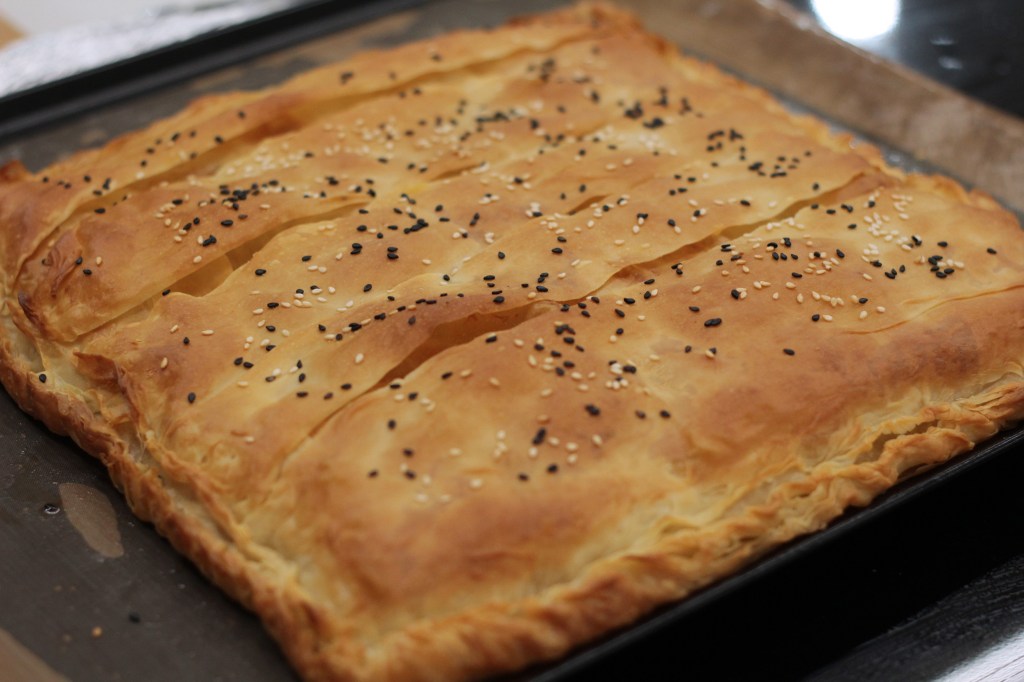
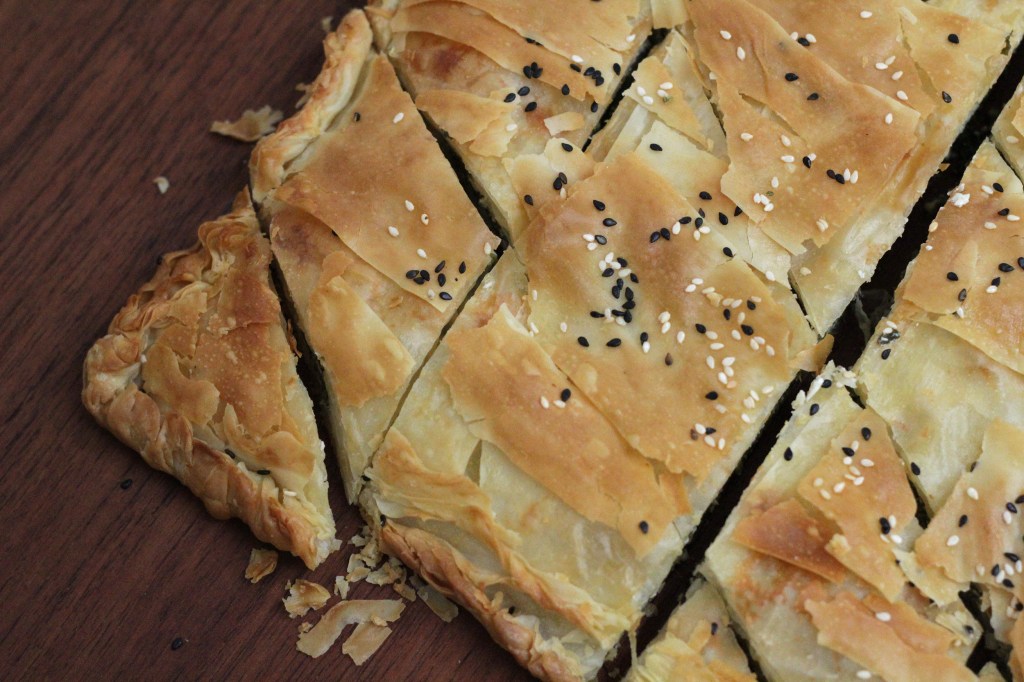
My main critique lay in my still-inexpert handling of the homemade phyllo. In my obsessive quest for perfection I had laid the phyllo layers smoothly and evenly, which actually hindered the baking process. Phyllo cooks best when the brushing of fat between the layers, along with wrinkles and tears, allow the evaporation of water to create pockets of air, that then allow the pastry to crisp up and separate into distinct, flaky layers. A tip for handling phyllo pastry: work hard to be as messy and imperfect as possible.
It didn’t help that I was guessing how many sheets to use for both the top and bottom, resulting in an undercooked bottom. It was, thankfully, at least not soggy, which meant that I could resolve the issue for this particular pie by reheating pieces on a sandwich press or in a frying pan, allowing the base to cook a little further at the same time.
The flavour of the filling was, as I recalled, delicious. There were a few tweaks I wanted to make both to adjust for my own personal taste, as well as for authenticity. So this time I made some careful notes and began preparing for another imminent test kitchen.
***
It was several months before I managed to try again.
Life happened to get in the way, with changes to my work and personal circumstances meaning that energy, time and motivation to both cook and write took a severe hit.
Despite still feeling low on inspiration, as the end of 2021 rolled around I was stirred into action by the impending visit of my sister from interstate.
You may recall that this whole spanakopita discovery and endeavour began with a sisterly adventure. Being the savoury-lover in our pair (and she being the sweet tooth and avid baker), I still planned to perfect this pie for her, the same way she recipe-tested and perfected her lemon meringue pie recipe for me as a wedding gift. I dreamed of presenting a perfect pie to my sister upon her arrival.
So, as she boarded a plane elsewhere, I pulled out my frozen phyllo dough to defrost and masked up to set out for fresh spinach and feta, luckily still having to hand a fully-sealed pack of kefalograviera, along with the other pantry staples.
Working with homemade phyllo a third time was wonderful. By this point I knew how to handle the pastry to minimising it sticking to itself (and everything else), and was intentionally messy in layering up to ensure the resulting pie would have beautifully distinct layers. To address the previous issue of an undercooked base, I reduced the number of layers at the bottom and decided to build and bake the pie in a shallow cast iron casserole dish, maximising the heat distributed through the bottom.
I adjusted the filling with slightly less feta (I know, it seems like a betrayal), only a pinch of cayenne pepper, and cutting out the (intruding!) garlic entirely. Despite having rarely seen spanakopita with sesame seeds on top, I surrendered to Nagi’s suggestion of scattering both black and white seeds on top before baking because it just looks so pretty.
The resulting pie was perfect.
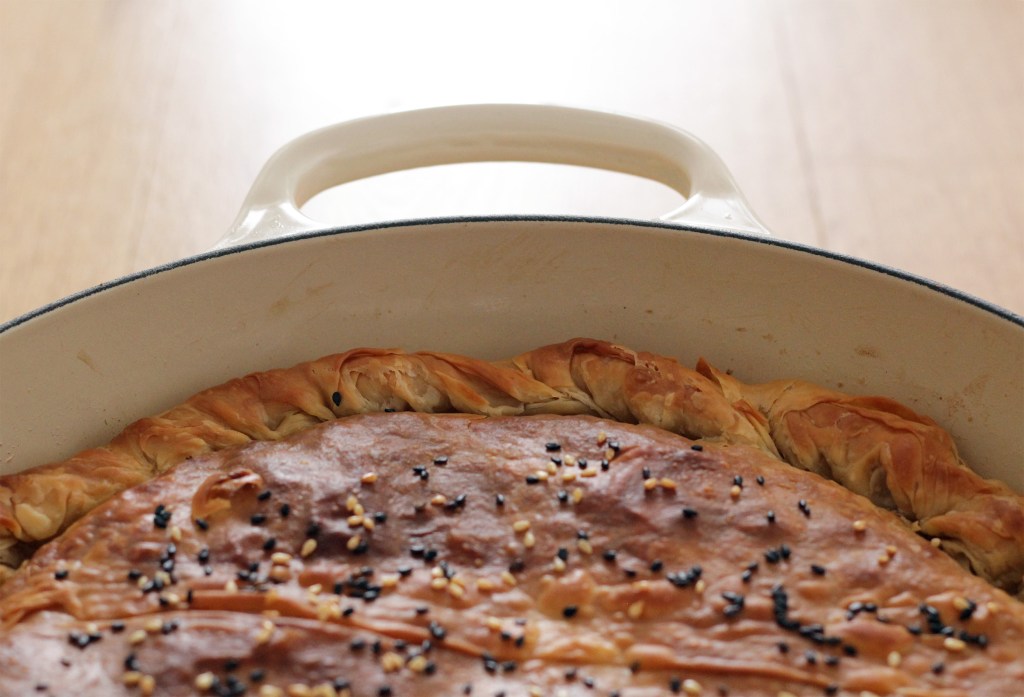
It was a glorious balance of crispy, crunchy pastry against the salty, creamy, earthy filling. The kefalograviera and butter layered through the dough gave the whole pie a saliva-inducing savoury deliciousness, and the herbs added just the right level of punchiness.
The hand-rolled crust of phyllo was, arguably, the best part. I am known for my obsession with bread crusts, brownie edges, and pastry crimps, but even I worried this one was a little too thick. My fears were unfounded, as it came out golden, buttery, flaky and delicious. The cherry on top was my sister declaring that she, too, felt the crust was her favourite.
I was finally recipe to document the recipe.
 The Foodiarist