Jump to recipe
New to my spanakopita series? Catch up on the story so far here and read about my many piemaking disasters before I perfected this recipe.
***
The recipe for this delectable pie comes from years of research (read: eating a piece of every spanakopita I came across) and months of recipe testing. It’s not a wholly authentic recipe, as I have zero Greek heritage or cultural connections, but it is as close as I felt I could get to the perfect genuine Greek spanakopita. It’s the perfect balance of a golden, flaky, buttery crust, that is sturdy enough to hold its own against a rich, robust and flavoursome filling of spinach, herbs and cheese. The idea for finely grating kefalograviera cheese between the top layers of the pie pastry comes wholly from Nagi of RecipeTin eats, to whom I am forever indebted for this.
Rolling your own phyllo pastry is no mean feat, and if you plan to do so you’ll need to dedicate a couple of hours to the entire pie-construction. Using an electronic pasta roller (or attachment for a stand mixer, like I used) speeds up the process and enables you to get pastry that is almost as thin as any you can buy, though it means you’ll be working in long strips rather than large sheets, but they are flexible and fun to work with. Yes, you can easily substitute store-bought phyllo pastry which is thinner and flakier, but I find resulting pie is not quite as satisfying—and certainly the hand-crimped pie edges are much less exciting when using the commercial stuff.
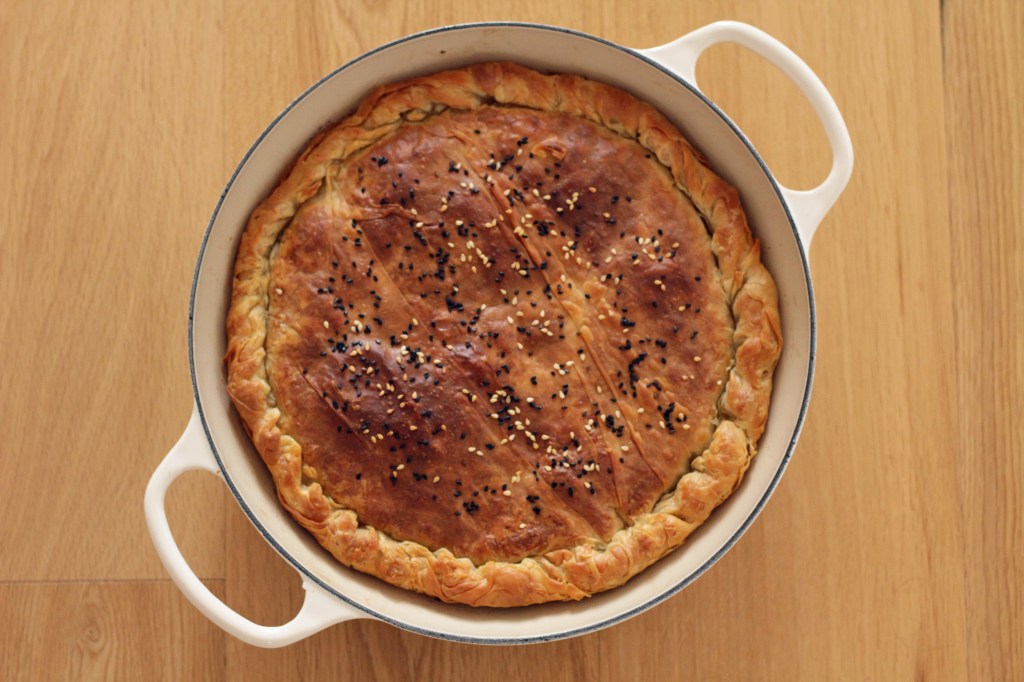
Spanakopita (Greek spinach pie) with homemade phyllo pastry
You can substitute store-bought phyllo pastry for this recipe, though the results won’t be as good (especially not that crust!), and you will need more layers. Either way, try to be a little messy and scrappy with your pastry, wrinkling it as you go and not worrying about small tears; this will allow the butter to heat up and create distinct, flaky layers that cook all the way through.
You will also need a large (30cm) shallow, heavy-based, ovenproof cast iron casserole dish or similar frying pan, or equivalent pie dish. Alternatively, you can bake the pie on a large, lined, flat baking sheet or roasting tray, though it would benefit from a pre-heated pizza stone underneath to ensure the bottom layers crisp up well and cook through, and the pie doesn’t end up soggy.
Ingredients
For the phyllo pastry (adapted from Greek by George Calombaris):
- 400g plain flour
- 2 tbs extra virgin olive oil
- 200mL warm water
- 3/4 tsp salt
- Cornflour for dusting
For the filling:
- 350-400g raw spinach, including the stems and roots (real ‘English spinach’, not the baby stuff)
- 80g (2-3 whole) spring onions (also known as green onions or green shallots)
- 10g dill
- 10g mint leaves, picked
- 125g thick Greek yoghurt
- 150g Greek feta
- 1 lemon
- 1/4 tsp salt, plus extra for sweating the spinach
- 1/2 tsp nutmeg
- 1/4 tsp black pepper
- pinch cayenne pepper
- 1 egg
For construction:
- unsalted butter
- 100g kefalograviera cheese, finely grated (alternatively, use a good quality pecorino or parmesan cheese)
- black and white sesame seeds
Method
- If making the phyllo pastry by hand, place the flour, salt, olive oil and warm water in the bowl of a food processor. Blitz for a couple of minutes until the ingredients come together in a ball.
- Tip the dough ball onto your counter or a clean board, and knead until smooth.
- Lightly grease a bowl, place the dough into the ball, and cover the bowl with a plate, silicone lid or damp tea towel. Leave to rest for 2 hours.
- After about 1 hour, begin working on your filling. Wash the spinach leaves, stems and roots very well (spinach is notoriously gritty!). You can spin the spinach dry in a salad spinner or pat with a clean tea towel at this point but it’s not essential.
- Trim the gnarly roots, roughly chop the leaves and stems and weigh out 300g. You can add some of the chopped roots to make up the total weight.
- Set the chopped spinach in a bowl, sprinkle with salt and massage it into the spinach with your fingers. Set aside for 15-20 minutes.
- Once the spinach has sweated, take a large handful at a time, place it in the middle of a clean tea towel, wrap it tight and squeeze as hard as you can over the sink to remove as much water as possible. Repeat this with all the spinach.
- Wipe out the bowl, return the spinach to it, then finely slice the spring onions and chop the herbs, and add these to the bowl.
- Crumble the feta in as well, then stir in the yoghurt, spices, the finely grated zest and a squeeze of juice from the lemon.
- Mix well, taste and adjust to your liking, whether you want to add a pinch more cayenne or more lemon juice perhaps. Be careful with salt, keeping in mind that there will be the salty cheese layered through the top of the pie as well.
- Once you’re happy with the taste, lightly beat the egg and add it to the filling. Mix well and set aside.
- After the dough has rested, use a sharp knife or dough scraper to divide the dough into 8 equal pieces. Shape each gently into an approximate square or rectangle, about 1-1.5cm thick. Dust the counter and each piece with cornflour (to prevent sticking), cover with a clean towel and leave to rest for 10 minutes.
- Meanwhile, get your pasta roller ready and melt some butter in a heatproof bowl. Prepare your casserole/baking dish by brushing the melted butter liberally over the bottom and up the sides.
- Preheat the oven to 205°C fan-forced. If your oven doesn’t take long to heat up, you may like to do this later, once the pie is partially assembled.
- Once the dough has rested, roll one piece through the pasta roller, starting on the thickest setting and working your way through each setting until you reach the thinnest. Continue dusting with cornflour on both sides as necessary, to prevent the dough from getting stuck in the roller. If the pieces get too long and unwieldy towards the end of rolling, you might need to cut it in half then continue rolling. Don’t forget to dust the counter with cornflour too, for wherever you’re leaving the other half in the meantime, and keep the unused dough squares covered with the tea towel while you’re working.
- As you roll the sheets of phyllo, begin using them immediately. Lay them in the buttered dish overlapping at the edges slightly, and leaving pastry working up the sides or just slightly overhanging the edges. Ensure you scrunch and wrinkle the pasty as you go.
- Brush more melted butter on top of the layer of phyllo, and continue rolling and layering until you have 4 full layers on the base, alternating the direction you lay the strips in. If using store-bought phyllo pastry, work the same way but trim the sheets down to a square to fit your baking dish with the edges overhanging, and rotate each piece slightly as you layer. You will need 6 layers of store-bought phyllo pastry on the bottom.
- Tip the filling mixture on top of the layered phyllo, and smooth it down evenly using the back of your spoon or a spatula, and neaten the edges.
- Continue working with the phyllo, but this time, between the first 4 layers, in addition to the brushing of melted butter, sprinkle a small handful (approx. 25g) of finely grated kefalograviera cheese.
- After the first 4 layers of phyllo are done, lay down 2 more layers of phyllo brushing only butter in between. You should have used up all or most of the phyllo dough. If using store-bought phyllo pastry, you will need 8 layers on top, with 6 of them with cheese between and the top 2 without. Continue rotating them as you work, as you did for the base.
- Gently peel the edges of the pastry back from the sides of your buttered dish, and start rolling them back inwards and pinching with your fingers as you go to seal the crust and create a crimped effect.
- Once the entire pie crust is rolled and sealed, brush the top and around the edges with more melted butter, then sprinkle a mix of sesame seeds on top.
- Place in the bottom third of the oven and bake for 30-35 minutes until the top and crust are golden brown. You can use a heat-proof spatula to gently lift one edge of the pie and peek at the bottom to ensure it’s cooked and also lightly golden. If not, cover the pie with a lid or tent with foil and return to the oven for a further 5 minutes.
- Remove from the oven and let rest for 15-20 minutes before removing it from the hot dish to a board, and cutting into pieces however you like. Enjoy!
Notes: I have successfully assembled the pie the evening before and refrigerated it overnight before baking the following morning. If using this approach, make sure to butter the top and cover it before refrigerating, then take the pie out of the fridge at least one hour before you want to bake it to allow it to come down to room temperature.
You can also make the phyllo dough in advance and freeze it for a couple of months. Ensure it’s well-wrapped in plastic wrap and in an airtight container before freezing. It will need an hour or so out of the fridge to thaw, or can be thawed overnight in the fridge, before rolling.

 The Foodiarist