
New to my spanakopita series? Catch up on the story so far here.
***
You could be forgiven for thinking that, after the success of my second pie, there wouldn’t be any more recipe attempting or tinkering.
But I was still itching to try my hand at homemade pastry and, in the interests of being thorough in my research, I still had at least three other recipes I wanted to try to experiment with for the filling.
Feeling invigorated by my recent success, I had another scan of my options and settled on the recipe for Hortopita from Peter of Souvlaki for the Soul.
For my my first two attempts, I had used spanakopita recipes that were, very obviously, not Greek, so I was pleased to look to something more authentic. I’ve been sporadically following Peter’s food blog for a few years, ever since discovering his recipe for a Kale and Feta bread. This bread is now one of my staple savoury bakes and is—to this day—one of the very few ways I will consent to eat kale.
‘Horto’, unlike ‘spana’, refers to wild greens rather than spinach. I wasn’t exactly planning to forage for wild greens in suburban Brisbane (although our poorly-maintained back lawn does routinely offer a veritable smorgasbord of them, including the dandelions Peter refers to). In lieu of the authentic wild greens gathered in Greece, Peter suggests using a mix of any dark hardy greens, such as kale or silverbeet (chard). At this point I still had a fridge full of spinach, silverbeet and three different types of kale from a recent farm box order, so I was set.
I was most excited about the fact that Peter’s hortopita recipe doesn’t bother with removing any liquid from the greens: no wilting or blanching, no cooking, and no salting-and-sweating either. While spinach is more than 90 percent water, other robust greens don’t comprise or release as much liquid and therefore don’t create quite so soggy-a-pie even if they haven’t been dehydrated in any way. But I was also (not insignificantly) excited about my first attempt at homemade spanakopita pastry. Peter’s recipe calls for simply popping all the dough ingredients into a food processor and letting it do the work. I adore my food processor so these instructions had initially endeared the recipe to me even more than the instructions not to bother cooking the greens. This whole pie would be a breeze!
It not a breeze.
It was a gale force wind akin to a cyclone.
With my food processor-coloured-glasses on, I had neglected to observe that the recipe gave little instruction for the pastry beyond running the food processor until the dough comes together into a ball.
Once my ingredients were in the processor and blitzing, they refused to come together into a ball. But I had no idea what texture I was looking for in this dough to determine what to add to address the issue. Water? Another egg? More olive oil?
I was already pushing the boundaries on the ‘max’ line on my poor processor, so I tipped the whole lot onto the counter to continue working by hand. I still wasn’t sure what the desired outcome should be, given that a food processor is usually used for pastry that requires a light hand, but most other phyllo recipes I had read up on called for kneading ‘until smooth and elastic’. I apprehensively drizzled a little more oil into the mix until the aforementioned ball emerged, and tried to follow my instincts and have faith. I added a splash more water and continued to work the dough, my kneading getting increasingly, aggressively desperate as my optimism quickly waned.
Eventually the dough began to smooth out, though it was not entirely as elastic as I’d expect. I wrapped it up and popped it dubiously into the fridge, hoping an hour to chill would help the dough emerge from its cling-wrapped cocoon as a stretchy, soon-to-be-flaky phyllo.
Brow still furrowed, I turned my attention back to my toddler, who had meanwhile been quietly drawing on the coffee table, only to discover that he had, in fact, been drawing on the coffee table.
I paused to clean the mess and to swap out the (thankfully whiteboard) markers with safer coloured pencils, returned to the kitchen to prepare my filling.
Making the filling was, in fact, a breeze.
I had settled on a combination of English spinach, green kale and black kale (cavolo nero). As I had once again washed, weighed and prepped the greens beforehand, all that was left to do was chop them to the requisite size and stir through the herbs, eggs and cheeses. As I peered into the bowl, I did note with some trepidation that the cheese-to-greens ratio seemed decidedly off, in favour of the greens. But I brushed my concerns away by reminding myself that the greens would cook down and reduce in volume, thereby (surely!) balancing the scales.
My hour passed and I pulled my dough ball out of the fridge which looked, well, no different to how it did going in: stiff and kind of bland.
Believe it or not, I persevered. I diligently divided my dough in two, rolled it out to an undisclosed thickness that would hopefully suit, spread my filling mixture across the top, laid out the top sheet of pastry and began to seal the edges.
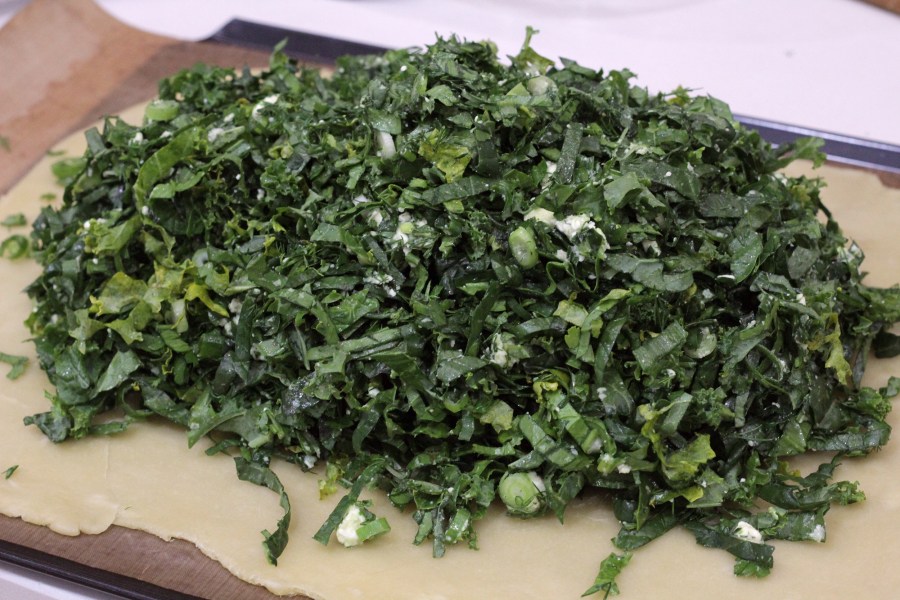
I noted with some relief that my edges were coming together in a freeform crimp that reminded me strongly of the many store-bought slices of spanakopita I had enjoyed over the years, and I began to curl and pinch with more gusto.
As I crimped the final corner, I spied my salt canister beside me. Untouched.
I had forgotten to salt the filling.
This oversight honestly compromised the integrity of the trial beyond repair. Salt does many things, of which lifting flavour is arguably the least important in this context, but it was too late to address the issue. No really, it was much too late. It was already 6pm and I hadn’t even started on that night’s dinner, and toddlers aren’t known for their patience.
Wincing with regret, I poked some holes in the top and brushed it with oil, then threw the whole thing into the oven and resigned myself (and the pie) to our fate.
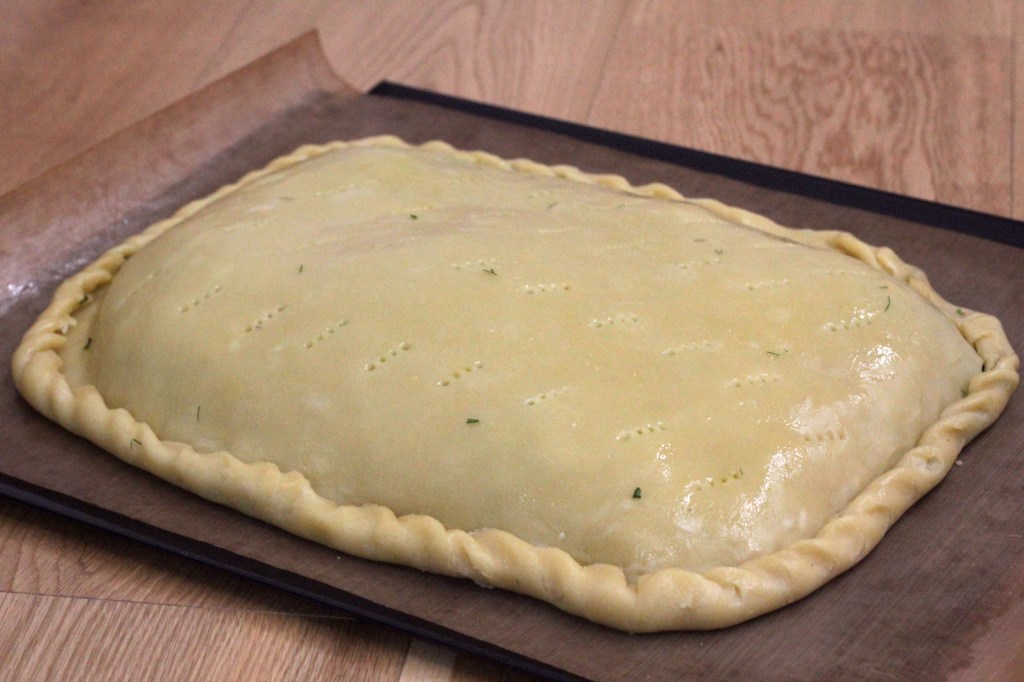
40 minutes in, I checked on my pie. It looked…. Doughy. Dry, perhaps. Where was my softly golden crust, with the sheen of olive oil? Was the oven even on? Consulting the images from the recipe and honing my attention in on the dough, I saw that it looked pretty accurate. But unlike what I had actually expected.
I’m not sure how I expected layers to form when I did no laminating and I certainly didn’t layer as I constructed the pie. It suddenly dawned on me that this wasn’t actually homemade phyllo. It was just a regular dough. Well, it was an irregular dough—as, to this day, I’m still uncertain whether I achieved the texture Peter had intended—but it was a bog-standard flour-and-water mix-and-roll sort of dough. Somehow I neglected to notice that in all my research and recipe planning. Rookie error.
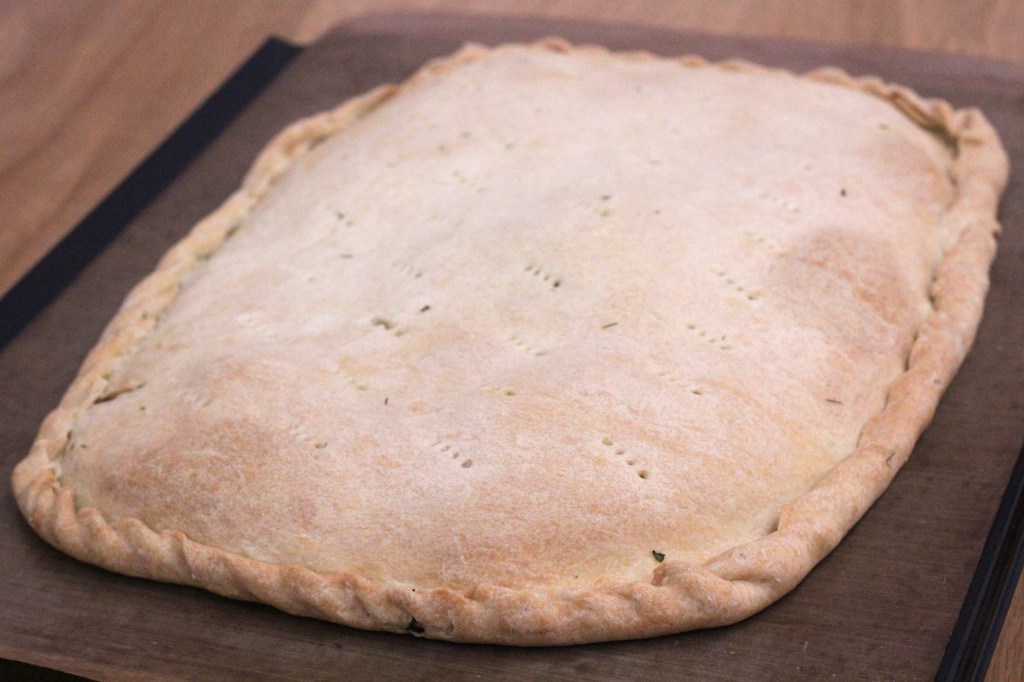
Once the pie was baked, the recipe insisted on leaving it to rest for an hour. This gave me time to settle our toddler into bed before I myself could settle down with a slice of spanakopita and give it the undivided attention it deserved. I was undoubtedly apprehensive as I sawed into the thick, sturdy (some might say, rock hard) crust, but the earthy scent of dill that wafted up as I cracked through was at least familiar.
This is where the similarities ended between the spanakopita of my dreams and the pie I made that day. I had made an entirely different sort of pie.
The filling tasted overwhelmingly of, well, kale. And kale wholly untempered by adequate seasoning. The balance still sat in favour of the greens, while the dairy melted vaguely into the background. And the pastry was a crumbly, sort of shortcrust-style dough with an almost wholemeal flavour. No crispy, buttery layers in sight.
My Spanakopita Test Kitchen had further to go than I thought.
Peter’s recipe would be great for anyone who wants an earthy, robust pie, or anyone who is vegan or lactose intolerant and can happily substitute the dairy for suitable options without compromising the end result. It is also perfect, of course, for anyone who genuinely enjoys the taste of kale.
I am none of these people.
If you, too, do not fit this criteria, then read on for my further testing pursuits. If a kale pie makes your mouth water then the link to the recipe is at the top of this post.
Just don’t forget the salt.
 The Foodiarist
[…] a tapsi, and figured my chances of rolling phyllo using this method were slim to nil. And after the questionable results from my attempt to follow another pie from Peter’s blog, I was dubious that his recipe would be to my taste or general cooking […]
LikeLike