New to my spanakopita series? Catch up on the story so far here.
***
Where I last left you, I had just finalised my shortlist of contenders for the perfect spanakopita. Yasmin Khan’s latest book Ripe Figs was already open on my kitchen cookbook stand, so her recipe seemed the natural place to start.
If my first spanakopita post has given you any indication of how long it took me to reach this particular point, you can likely understand that, once I had settled on the recipes, I wanted to jump right in. Nothing could deter me.
I finalised my shortlist on a long weekend, but as the public holiday Monday rolled around, already there was mounting opposition to my first Spanakopita Test Kitchen session: I had limited toddler-free-time; I was attempting a new recipe while fasting (for Ramadhaan); and I didn’t even have all the ingredients to hand, nor would I necessarily be able to source them with public holiday store closures.
But I had set my heart on spanakopita for dinner, so spanakopita we would have.
After dropping my son off to his grandparents’ place and starting the clock on my precious allotment of babysitting hours, I ventured out grocery shopping. Today’s test kitchen recipe called for a crust of commercially made phyllo, brushed liberally with olive oil and carefully tucked into a pie tin. The filling recipe was a pretty standard combination of cooked onion and spring onion, with wilted silverbeet and spinach, then finished off with a generous addition of herbs and crumbled feta.
I already had the phyllo to hand as leftover from our family Ramadhaan preps (a story for another time), and I luckily had two blocks of feta as part of my ‘pantry staples’—both regular Greek feta, and camel milk Persian style feta for my lactose-intolerant husband’s pie. With these key ingredients tucked under my belt, I was confident that my first stop would be my only stop, and I headed off to our local greengrocer around the corner that, conveniently, operates 24/7 and also does not let trifles like public holidays and pandemics slow down its operations.
I returned home with my bounty much later than I should have, and took a moment to survey my kitchen counter.

The sight called to mind visions of Iranian stallholders guarding hay-bale sized bundles of fresh herbs, or sabzi, at their market store, as customers wove their way through the vivid, fragrant mountain range gathering their provisions. I must have been Iranian in a past life because the abundance of herbs called for in Iranian cooking makes me giddy with excitement. Certainly my ordinary Aussie herb bunches weren’t quite as vast, and my sterile white kitchen didn’t evoke quite the same atmosphere, but I felt inspired nonetheless.
My optimism was as vibrant as the greens before me.
Unfortunately, I am not Iranian in this life which means that I didn’t grow up cleaning and preparing this sort of volume of greens on a regular basis, and I am entirely ill-equipped for the feat. Every time I have been faced with the task in the past, I have ended up frazzled, anxiety mounting with every stray green trimming that clogs my sink and dots my floor. Every surface ends up wet and partly sandy, and I ultimately pull out every prep bowl I own (which is a lot) to try to contain and categorise the mess.
I had hoped that this time would be different, being the first of such occasions in my new, overlarge kitchen with abundant workspace that I had carefully designed myself for just such a purpose.
Dear reader, it was not different.
Conscious of the clock ticking, I tried to rush the process. But my salad spinner is not Iranian-herb-quantity sized and I had to work in batches upon batches while trying to trim and wash the myriad greens. Each of my prep bowls emerged, once again, as I struggled to keep track of which ones’ contents were clean, dry, or neither. Moving back and forth between my spacious kitchen island bench and the sink at the opposite counter was not a recipe for tidy working. Very quickly my floor came to be decorated with drops of water in varying shades of green and a confetti of straggly herbs, slightly tacky under my slippered feet, not unlike a pub floor the morning after St Patrick’s Day.
Eventually my spinach, silverbeet, spring onions, parsley, dill and mint were clean (even if my kitchen was not) and I was ready to cook it down—technically only the second step of the recipe. Lifting the lid on my pot at the end of cooking revealed a sadly shrunken, wilted pile of greens that, while unsurprising, still made me want to weep with how little filling was left to show for my efforts of the previous hours.
At this point the recipe called for transferring the cooked greens to colander to sit for 10 minutes, until cool enough to handle and you can squeeze out any excess moisture with your hands.
I suspect the ’10 minutes until cool enough to handle’ here is not unlike the ’10 minutes’ it takes to caramelise onions because my blistered hands tell a different story. If I weren’t short on time (or so stubborn), I would have left the greens to cool longer; but at this point the adrenaline and stress had pushed my emotions close to the surface so I opted instead for cursing out loud and declaring that, after this, I was calling off the Spanakopita Test Kitchen entirely because, really, how hard could it have been to find in a store? I probably just hadn’t searched hard enough.
I was eager to just get the darn thing in the oven by now and I honestly couldn’t remember why I had ever thought DIY pie was a good idea.
At least the last step—assembling the spanakopita—was relatively straightforward.
I know a lot of people struggle to handle phyllo pastry but, compared to the greens marathon, I felt this part was a breeze. It’s also another example of how you can learn some things in the kitchen just by watching them countless times. Having seen my mother work with phyllo pastry for Ramadhaan year on year, I knew some of the basics: use it at room temperature, work with one layer at a time, don’t let it dry out or it will become brittle, brush the fat between the layers but don’t be too precious…
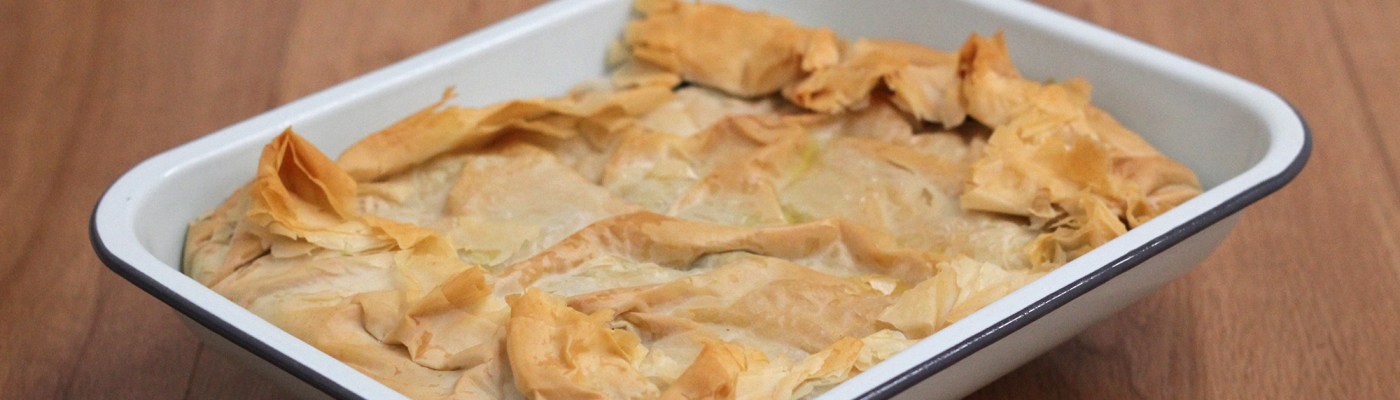
I had measured out and oiled my pie dish ahead of time, so layering the delicate phyllo with oil then pouring in the filling, wrapping it up and tucking it in was really quite a tidy, quick and satisfying end to the process.

***
We did eat spanakopita for dinner that night, as I had dreamed we would. But I knew at first bite that this particular recipe was not my perfect recipe. It was immediately apparent to me that, as I had initially suspected, commercial phyllo pastry would not yield my desired results. I wanted a sturdier, more flavoursome, crustier crust. And more of it.
As for the filling, it was difficult to make an assessment straight away as, like most spanakopita, it benefitted from time to rest and cool (certainly more than 10 minutes), and to allow the flavours to develop. But as I munched thoughtfully on the leftovers the following day I determined that I was after more greens and less feta. This realisation also caused me no small amount of mental anguish; who in their right mind ever opts for less cheese?
Finally, I concluded that I also wanted a more al dente textural feel for my pie filling. The heartily cooked down greens that made me sob earlier translated to a filling that lacked the heartiness my tastebuds sought. I wasn’t yet sure how to address this, whether I might prefer more silverbeet and its stems, or perhaps even celery ala Ottolenghi’s recipe.
I hoped time would tell.
Time and, of course, more recipe testing.
As the adrenaline had subsided, my clarity of mind intensified; I shamefacedly extracted my Spanakopita Test Kitchen commitment from where it had been discarded, dusted it off, pulled it back on, and carried on my way.
 The Foodiarist